If you’ve ever been told you have a bulging disc, herniated disc, or degenerative disc disease, you may have wondered:
“Why is this taking so long to heal?”
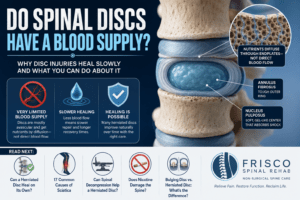
One of the biggest reasons is that the discs in your spine have a very limited blood supply.
Unlike muscles, skin, or many other tissues in the body, the intervertebral discs don’t receive a rich network of blood vessels. This unique anatomy helps explain why disc injuries often heal more slowly—and why protecting your spine before problems develop is so important.
What Is a Spinal Disc?
Spinal discs are the soft cushions located between the bones (vertebrae) of your spine.
Each disc has two main parts:
Together, these structures allow your spine to bend, twist, and absorb the forces of everyday life.
Do Discs Have a Blood Supply?
The answer is yes—but very little.
During childhood, spinal discs contain more blood vessels. As we reach adulthood, most of those blood vessels disappear.
In healthy adults, the center of the disc is essentially avascular, meaning it has little to no direct blood supply. Instead, nutrients and oxygen reach the disc by diffusion through the cartilage endplates from the vertebrae above and below.
Think of it like watering a plant through the soil instead of spraying the leaves directly. Nutrients slowly move into the disc rather than being delivered by a rich blood supply.
Why Does That Matter?
Blood carries oxygen, nutrients, immune cells, and healing factors.
Because spinal discs receive relatively little direct blood flow, they generally heal more slowly than tissues such as muscles or skin.
That’s one reason a muscle strain may improve in a few weeks, while a symptomatic disc injury can take months to settle down.
Can a Herniated Disc Heal?
Surprisingly, yes.
Many people assume that because discs have limited blood flow, a herniated disc can never improve. Fortunately, that’s not true.
Research has shown that many herniated discs gradually shrink over time as the body recognizes the displaced disc material and begins to break it down through natural inflammatory and immune processes.
This process doesn’t happen overnight. Depending on the size and type of herniation, it may take several months.
It’s also important to remember that MRI findings don’t always match symptoms. Some people have large herniated discs with little or no pain, while others experience significant symptoms from relatively small disc injuries.
What Affects Disc Health?
Several lifestyle factors can influence the health of your spinal discs, including:
Smoking and Nicotine
Nicotine reduces blood flow and can interfere with the delivery of nutrients to spinal tissues. Numerous studies have linked smoking with faster disc degeneration and poorer healing.
Movement
Although discs don’t have a rich blood supply, regular movement helps promote the exchange of nutrients through the vertebral endplates.
Long periods of inactivity may reduce this natural nutrient exchange.
Weight
Excess body weight increases the mechanical load placed on the discs, which may accelerate wear over time.
Aging
As we age, discs gradually lose water content and become less flexible. This is a normal part of aging, although not everyone develops pain as a result.
Does Limited Blood Supply Mean Surgery Is Inevitable?
No.
Many patients with disc-related pain improve without surgery.
Treatment depends on several factors, including:
Some patients recover with activity modification, targeted exercise, and conservative care. Others may require injections or surgery if significant nerve compression or progressive weakness is present.
The key is identifying the cause of your symptoms and choosing the treatment that’s appropriate for your specific condition.
Do spinal discs have blood vessels?
No. In healthy adults, the center of the spinal disc has little to no direct blood supply. Instead, nutrients reach the disc through diffusion from the vertebrae above and below.
Can a herniated disc heal if it doesn’t have much blood supply?
Yes. Many herniated discs improve over time through the body’s natural inflammatory and immune response, although healing is usually slower than in tissues with a richer blood supply.
Why do spinal discs heal so slowly?
Because they receive limited oxygen and nutrients through diffusion rather than direct blood vessels, repair processes generally take longer than they do in muscles or skin.
Does walking help nourish spinal discs?
Regular movement helps promote the exchange of nutrients through the vertebral endplates, making moderate activity an important part of maintaining disc health.
The Bottom Line
Spinal discs have a very limited blood supply, which helps explain why disc injuries often heal more slowly than many other injuries.
However, limited blood flow does not mean healing is impossible. Many disc injuries improve over time, and many patients recover without surgery.
If you’re struggling with ongoing back pain, leg pain, or sciatica, the most important step is determining why your symptoms are occurring. A thorough evaluation can help identify the underlying problem and guide the most appropriate treatment plan.
At Frisco Spinal Rehab, Dr. David Kaff and Dr. Jason Wayne evaluate patients with disc-related back pain, herniated discs, degenerative disc disease, and sciatica to determine whether conservative, non-surgical treatment may be appropriate.
Read Next:
Can a Herniated Disc Heal on Its Own?
Can Spinal Decompression Help a Herniated Disc?
Does Nicotine Damage the Spine?
Bulging Disc vs. Herniated Disc: What’s the Difference?
Back Pain & Spine Specialists in Frisco, TX | DRX9000 Spinal Decompression


