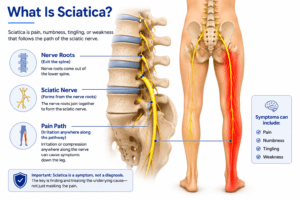
If you’ve ever felt a sharp, burning pain shoot from your lower back into your buttock, thigh, calf, or even your foot, you’ve probably heard the word sciatica.
For many people, that diagnosis raises more questions than answers.
What caused it?
Will it go away?
Do I need surgery?
Can a chiropractor actually help?
Here’s the first thing you should know:
Sciatica is not actually a diagnosis. It’s a symptom.
Sciatica simply means the sciatic nerve—or one of the nerve roots that eventually forms the sciatic nerve—is irritated or compressed. The real challenge is figuring out why.
That distinction matters because there isn’t one treatment that works for every patient with sciatica.
A herniated disc often requires a very different approach than spinal stenosis. A tight piriformis muscle is treated differently than an inflamed sacroiliac (SI) joint. Even conditions like hip arthritis or peripheral neuropathy can mimic sciatica, leading people down the wrong treatment path.
One of the most common things we hear from new patients at Frisco Spinal Rehab is:
“I’ve been told I have sciatica, but nobody has explained what’s actually causing it.”
That’s exactly why we created this guide.
By the end of this article, you’ll understand the 17 most common causes of sciatica, how they differ from one another, which symptoms tend to point toward each condition, and when it’s time to seek professional evaluation.
Key Takeaways
If you only remember five things from this article, remember these:
Quick Navigation
In this guide we’ll cover:
We’ll also discuss:
Before We Begin…
One important point deserves repeating:
Not all leg pain is sciatica.
Pain traveling down the leg may come from muscles, joints, blood vessels, or peripheral nerves—not necessarily the sciatic nerve.
Likewise, not every MRI finding is responsible for your symptoms.
Research has shown that many adults with no back pain at all have bulging discs or degenerative changes on MRI. Imaging is an important tool, but it always has to be interpreted alongside your symptoms and physical examination.
That’s why a thorough evaluation is so important.
Dr. Kaff’s Clinical Insight
One of the biggest misconceptions I see is patients assuming that every case of leg pain is caused by a “pinched nerve.” In reality, I’ve evaluated patients whose MRI looked terrible but weren’t experiencing sciatica, while others had only a small disc herniation that perfectly explained their symptoms. The MRI is only one piece of the puzzle. Your history, physical examination, and neurological findings are just as important when determining the true cause of sciatic pain.
The 17 Most Common Causes of Sciatica
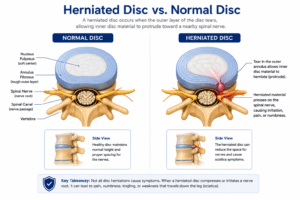
If someone develops sudden sciatica after lifting something heavy, bending awkwardly, or even sneezing, a lumbar disc herniation is often the first condition we consider.
Between each vertebra sits a spinal disc that acts like a shock absorber. Think of it as a jelly-filled cushion. When the tough outer layer of the disc tears, some of the softer inner material can protrude outward and irritate a nearby nerve root.
Interestingly, the pain isn’t always caused by pressure alone. The disc material itself contains inflammatory chemicals that can irritate the nerve, which helps explain why even relatively small herniations sometimes cause severe symptoms.
Common Symptoms
Patients with herniated disc sciatica often describe:
The exact location of the pain depends on which nerve root is affected.
For example, an L5 nerve root often causes pain along the outside of the leg into the top of the foot, while an S1 nerve root commonly produces pain into the calf and sole of the foot.
Can It Heal?
One encouraging fact that surprises many patients is that many herniated discs improve without surgery.
The body can gradually reduce inflammation and, in some cases, even reabsorb portions of the herniated disc over time. That’s one reason conservative treatment is often recommended before surgery when there are no serious neurological deficits or emergency warning signs.
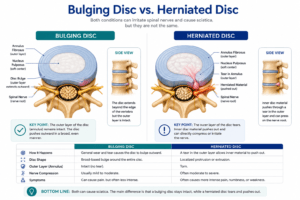
Many people assume a bulging disc and a herniated disc are the same thing, but they’re actually different.
With a bulging disc, the outer layer of the disc remains intact. Instead of rupturing, the disc simply extends beyond its normal boundaries.
In fact, bulging discs are extremely common, especially as we get older. Many never cause symptoms at all.
Problems arise only when the bulging portion of the disc narrows the space around a nerve root or contributes to inflammation.
Common Symptoms
Depending on its location, a bulging disc may cause:
One important difference from a herniated disc is that bulging disc symptoms often develop more gradually rather than appearing suddenly after an injury.
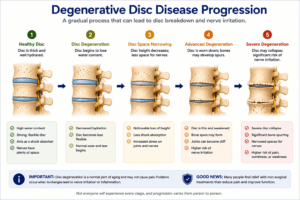
Despite its name, degenerative disc disease isn’t actually a disease.
It’s a natural age-related process in which spinal discs gradually lose water content, become thinner, and lose some of their ability to absorb shock.
As the disc loses height, the openings where spinal nerves exit the spine can become smaller. This narrowing may eventually contribute to sciatic nerve irritation.
Some people have significant degeneration with little discomfort, while others develop chronic pain from relatively modest changes.
Common Symptoms
Patients often report:
Because degeneration usually develops slowly over many years, symptoms often come and go before becoming more persistent.
Comparison Table
| Condition | Typical Age | Pain Pattern | Sitting | Walking | Often Improves Without Surgery |
| Herniated Disc | 20–55 | Sharp pain below the knee | Often worse | Variable | Frequently |
| Bulging Disc | 30+ | Intermittent leg pain | Sometimes worse | Usually tolerated | Often |
| Degenerative Disc Disease | 40+ | Back pain with occasional sciatica | Worse after prolonged sitting | Often improves after movement | Often |
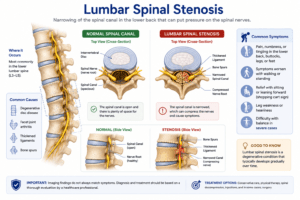
Lumbar spinal stenosis is one of the most common causes of sciatica in adults over the age of 60. Unlike a herniated disc, which often develops suddenly, spinal stenosis usually develops gradually over many years.
The spinal canal is the tunnel that protects the spinal cord and nerve roots. As we age, arthritis, thickened ligaments, enlarged facet joints, and bulging discs can slowly narrow this space. Eventually, there may not be enough room for the nerves to function normally.
Many patients don’t describe a sharp “pinched nerve” feeling. Instead, they notice that their legs simply become tired, heavy, weak, or painful after walking a certain distance.
One of the classic signs of lumbar spinal stenosis is something called neurogenic claudication. Patients often tell us:
“I can walk around Costco for about 10 minutes, but then I have to lean over the shopping cart because that’s the only way my legs feel better.”
Leaning forward temporarily opens the spinal canal and reduces pressure on the nerves, which explains why many people find relief while bending over a counter or pushing a shopping cart.
Common Symptoms
Dr. Kaff’s Clinical Insight
One of the easiest ways to distinguish spinal stenosis from a herniated disc is by asking what happens during walking. Herniated discs often become more painful with prolonged sitting, while spinal stenosis frequently becomes worse with walking or standing and improves when patients sit down or bend forward.
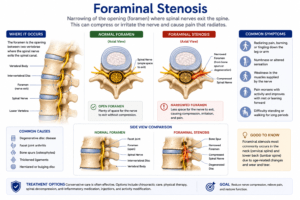
Although many people have heard of spinal stenosis, fewer know about foraminal stenosis.
Each spinal nerve exits the spine through a small opening called the foramen. These openings can become narrower because of arthritis, bone spurs, disc height loss, or a bulging disc.
Even though the main spinal canal may be completely normal, narrowing of just one foramen can irritate a single nerve root and produce significant sciatica.
Foraminal stenosis often develops slowly and symptoms may fluctuate depending on posture. Patients frequently notice pain while standing upright that eases somewhat when sitting or changing position.
Common Symptoms
Because foraminal stenosis affects one nerve root rather than the entire spinal canal, symptoms are often limited to one side.
Spondylolisthesis occurs when one vertebra slips forward over the vertebra beneath it.
This slippage can narrow the spaces around nearby nerves, contributing to sciatic pain.
Some people develop spondylolisthesis after years of arthritis, while others have a stress fracture that developed much earlier in life.
Not everyone with spondylolisthesis experiences symptoms. However, when nerves become irritated, patients may notice both mechanical back pain and radiating leg pain.
Common Symptoms
Treatment depends largely on the degree of slippage and whether the condition remains stable over time.
Bone spurs sound alarming, but they’re actually a very common part of the aging process.
As spinal joints become arthritic, the body sometimes responds by producing extra bone around those joints. These growths, called osteophytes, can gradually narrow the spaces surrounding nearby nerves.
Bone spurs usually don’t develop overnight. Instead, they contribute to symptoms gradually over many years.
Many patients have bone spurs visible on X-rays without experiencing any pain. Problems arise only when they begin compressing nearby nerves.
Common Symptoms
Bone spurs frequently occur together with degenerative disc disease and spinal stenosis, making careful evaluation important.
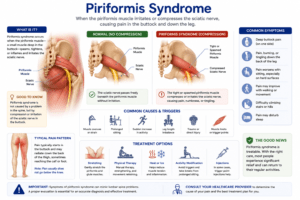
One of the biggest misconceptions about sciatica is that it always starts in the spine.
It doesn’t.
The piriformis muscle is a small muscle located deep within the buttock. The sciatic nerve travels underneath—or in some people, directly through—this muscle.
If the piriformis becomes tight, inflamed, or irritated, it can compress the sciatic nerve outside the spine.
This condition is called piriformis syndrome.
Unlike disc-related sciatica, patients often have little or no low back pain. Instead, they describe deep buttock pain that radiates down the back of the leg, especially after prolonged sitting, driving, or climbing stairs.
Common Symptoms
Dr. Kaff’s Clinical Insight
One of the biggest mistakes I see is assuming every case of buttock pain is piriformis syndrome. True piriformis syndrome exists, but it is much less common than lumbar disc injuries. A thorough examination helps distinguish between nerve irritation originating in the spine and compression occurring in the buttock.
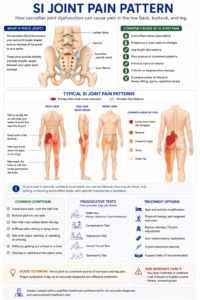
The sacroiliac joints connect the spine to the pelvis and are responsible for transferring forces between the upper body and the legs.
Although the SI joint does not directly compress the sciatic nerve, irritation or inflammation of this joint can create pain patterns that closely resemble sciatica.
Many patients are surprised to learn that SI joint pain can radiate into the buttock, thigh, and occasionally below the knee.
Because its symptoms overlap with lumbar disc problems, SI joint dysfunction is frequently misdiagnosed.
Common Symptoms
Specific orthopedic tests performed during a physical examination can often help differentiate SI joint dysfunction from true lumbar nerve root compression.
Comparison Table
| Condition | Typical Age | Pain Pattern | Hallmark Clue |
| Lumbar Spinal Stenosis | 60+ | One or both legs | Better leaning forward |
| Foraminal Stenosis | 50+ | One leg | Standing aggravates symptoms |
| Spondylolisthesis | Any | Back + leg pain | Worse after standing |
| Bone Spurs | 55+ | Gradual onset | Associated with arthritis |
| Piriformis Syndrome | Any | Buttock into leg | Little or no back pain |
| SI Joint Dysfunction | Any | Buttock and upper leg | Pain rolling in bed or climbing stairs |
Pregnancy is one of the few situations where sciatica can develop without a spinal injury.
As pregnancy progresses, several changes occur simultaneously:
Some women experience true sciatic nerve irritation, while others develop pelvic or SI joint pain that closely mimics sciatica.
Fortunately, symptoms often improve after delivery, although treatment during pregnancy should always be tailored to both the mother and baby’s safety.
Common Symptoms
Falls, lifting injuries, sports injuries, and motor vehicle accidents can all trigger sciatica.
Sometimes the injury causes a disc herniation. Other times it irritates muscles, ligaments, or joints that inflame nearby nerves.
One important point is that symptoms don’t always begin immediately. It’s not unusual for patients to feel relatively well after an accident, only to develop leg pain several days later as inflammation increases.
Common Symptoms
Many people assume that persistent leg pain after surgery automatically means the operation failed.
That’s not necessarily true.
Even after a technically successful procedure, scar tissue (epidural fibrosis) can develop around the nerve root during healing. In some patients, this scar tissue may contribute to ongoing nerve irritation.
Persistent pain after surgery should always be evaluated carefully because several different conditions—including recurrent disc herniation, spinal instability, or adjacent level degeneration—may produce similar symptoms.
Dr. Kaff’s Clinical Insight
One of the most rewarding patients to help is someone who has been told, “You’ll just have to live with it.” Persistent symptoms after surgery don’t always have a simple answer, but they deserve a thorough evaluation rather than assumptions. The first step is determining whether the pain is coming from scar tissue, a new disc problem, arthritis, or something entirely different.
Fortunately, spinal tumors are an uncommon cause of sciatica.
However, they are important because early diagnosis can be critical.
A tumor may compress a nerve root or weaken nearby bone, producing symptoms that resemble more common spinal conditions.
Warning Signs
Although these symptoms don’t necessarily mean cancer is present, they warrant prompt medical evaluation.
Serious spinal infections are also uncommon but require immediate medical attention.
Unlike typical sciatica, patients often feel generally ill.
Red Flags
These symptoms should never be ignored.
Not every burning pain in the legs is sciatica.
Diabetes can damage peripheral nerves, producing diabetic neuropathy, which sometimes mimics sciatic pain.
Unlike classic sciatica, diabetic neuropathy usually affects both feet and often begins with numbness or burning in the toes before gradually progressing upward.
Because treatment differs significantly, distinguishing between diabetic neuropathy and lumbar nerve compression is extremely important.
Synovial cysts are small, fluid-filled sacs that develop from arthritic facet joints.
Although many remain asymptomatic, larger cysts can occupy valuable space inside the spinal canal or nerve openings, irritating nearby nerve roots.
MRI is usually the best imaging study for identifying these cysts.
Symptoms often resemble spinal stenosis because both conditions reduce available space around the nerves.
Certain inflammatory diseases—including ankylosing spondylitis and other forms of inflammatory arthritis—may contribute to irritation of spinal joints, surrounding tissues, and nerve roots.
Unlike mechanical back pain, inflammatory pain often improves with movement and becomes worse after prolonged rest.
These conditions require a different treatment approach than disc injuries or arthritis.
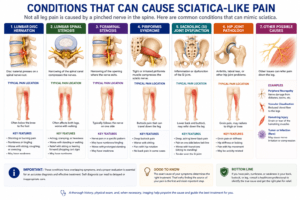
Conditions That Can Mimic Sciatica
One of the biggest reasons patients receive the wrong treatment is that not all leg pain is actually sciatica.
Several conditions closely resemble sciatic nerve pain.
These include:
A careful physical examination helps distinguish these conditions from true sciatic nerve irritation.
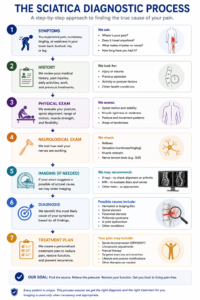
How Doctors Determine the Cause of Sciatica
Although MRI scans receive a lot of attention, they represent only one piece of the puzzle.
Disc Degeneration on MRI is common without symptoms.
A thorough evaluation usually begins with a detailed discussion of your symptoms.
Questions such as:
These answers often provide important diagnostic clues before any imaging is reviewed.
Next comes the physical examination.
Depending on your symptoms, your healthcare provider may perform:
Imaging studies—including MRI or X-rays—may then be recommended when appropriate to confirm the diagnosis or rule out more serious conditions.
Dr. Kaff’s Clinical Insight
The goal isn’t to find something abnormal on an MRI. The goal is to determine whether that MRI finding actually explains your symptoms. Many people have bulging discs or arthritis without pain. Successful treatment starts with matching the patient’s history, examination, and imaging—not treating the MRI alone.
Can Sciatica Be Treated Without Surgery?
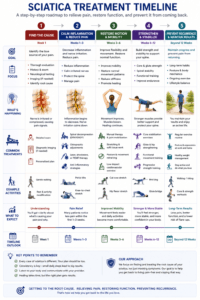
For many patients, yes.
In fact, many common causes of sciatica improve with conservative treatment when the underlying problem is correctly identified.
Treatment may include:
Surgery is sometimes the best option, particularly when there is progressive neurological loss, significant instability, certain structural abnormalities, or failure of appropriate conservative care.
The key is selecting the right treatment for the right diagnosis.
When Should You Seek Immediate Medical Attention?
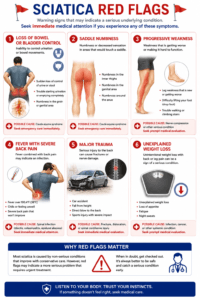
Although most cases of sciatica are not medical emergencies, certain symptoms require immediate evaluation.
Seek emergency medical care if you experience:
These symptoms may indicate serious conditions requiring urgent treatment.
Frequently Asked Questions
Can sciatica occur without back pain?
Yes. Some people experience pain primarily in the buttock or leg with very little discomfort in the lower back.
Can sciatica heal on its own?
Many cases improve over time, particularly those caused by inflammation or smaller disc injuries. However, persistent or worsening symptoms should be evaluated to identify the underlying cause.
Is walking good for sciatica?
It depends on the diagnosis. Walking may help some patients but aggravate others—particularly those with lumbar spinal stenosis. Your treatment plan should be based on the specific cause of your symptoms.
Does every herniated disc cause sciatica?
No. Many people have herniated or bulging discs on MRI without any leg pain. Symptoms occur only when the disc irritates or compresses a nearby nerve.
Can chiropractic care help sciatica?
Some patients benefit from chiropractic treatment, particularly when joint dysfunction contributes to their symptoms. However, treatment should always be individualized based on the underlying diagnosis.
Does everyone with sciatica need an MRI?
No. Many patients improve with conservative care and never require advanced imaging. MRI is generally recommended when symptoms are severe, persistent, progressive, or accompanied by neurological deficits or other concerning findings.
When is surgery necessary?
Surgery may be appropriate when there is progressive weakness, loss of bowel or bladder function, severe nerve compression, spinal instability, or persistent symptoms that do not improve despite appropriate conservative treatment.
Sciatica isn’t a diagnosis—it’s a signal that something is irritating the sciatic nerve. The challenge is identifying what that something is.
Whether the cause is a herniated disc, spinal stenosis, piriformis syndrome, SI joint dysfunction, or another condition entirely, the most effective treatment begins with an accurate diagnosis.
At Frisco Spinal Rehab, Dr. David Kaff and Dr. Jason Wayne begin every new patient evaluation with a detailed history, orthopedic and neurological examination, and a careful review of any available imaging. Rather than treating every case of leg pain the same way, the goal is to identify the underlying cause and recommend the most appropriate treatment—whether that involves conservative care, spinal decompression, rehabilitation, referral for injections, or surgical consultation when necessary.
If you’ve been told you “just have sciatica” but still don’t understand why, finding the answer is often the first step toward lasting relief.
Medical Disclaimer
The information in this article is provided for educational purposes only and should not be considered medical advice. Reading this article does not establish a doctor-patient relationship. Because every patient is unique, diagnosis and treatment recommendations should always be based on a thorough history, physical examination, and appropriate imaging when indicated. If you are experiencing severe pain, progressive weakness, loss of bowel or bladder control, or other concerning symptoms, seek immediate medical evaluation.
Article Details


