A familiar pattern brings a lot of people into our Frisco office: the back hurts, it settles down for a while, and then the pain returns. Sometimes it comes back after a long drive, a weekend project, a workout, or simply bending over to put on a shoe. Other times there is no obvious trigger at all.
After treating spine problems for approximately 25 years, we have learned not to assume that recurring back pain is just a problem with “tight muscles” or that the answer is simply another round of the same treatment. The more useful question is: why does it keep coming back?
At Frisco Spinal Rehab, that question comes before deciding whether DRX9000 spinal decompression, hands-on care, exercise, another conservative approach, or a medical referral makes the most sense.
Recurring pain does not necessarily mean that something is continually being damaged. Back pain is complicated, and symptoms can change even when the underlying anatomy has not. But when the same pain repeatedly returns, especially when it follows a recognizable pattern, it is worth looking for the mechanical and neurological factors that may be contributing.
“My back hurts” is only the beginning of the story. We want to know what happens next. Does the pain stay in the lower back, or travel into the buttock or leg? Is sitting worse than standing? Does coughing or sneezing aggravate it? Is there numbness or tingling? Does walking relieve the pain or make it worse? Does the patient feel fine in the morning but progressively worse after hours at a desk?
Those details matter because disc problems, irritated nerve roots, joint-related pain, muscular pain, and spinal stenosis do not always behave the same way. Two patients can point to almost the exact same spot on their lower backs and still need very different treatment plans.
Spinal discs sit between the vertebrae and help distribute load while allowing the spine to move. A disc can become dehydrated, degenerated, bulged, or herniated. Those findings are common, and an abnormal-looking disc on an MRI does not automatically mean it is causing pain.
What gets our attention is correlation. If the patient’s history, examination, neurological findings, and imaging all point toward the same spinal level or nerve distribution, a disc finding becomes more clinically meaningful.
For example, recurring low-back pain accompanied by pain into the buttock or leg, tingling, numbness, or certain patterns of weakness raises different questions than isolated soreness after exercise. That does not automatically make someone a candidate for decompression, but it gives us a better idea of what needs to be evaluated.
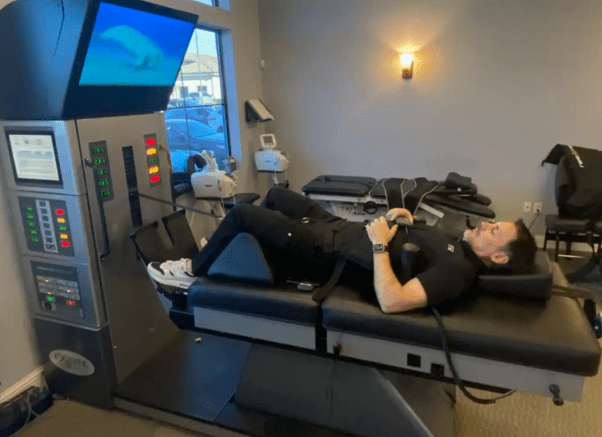
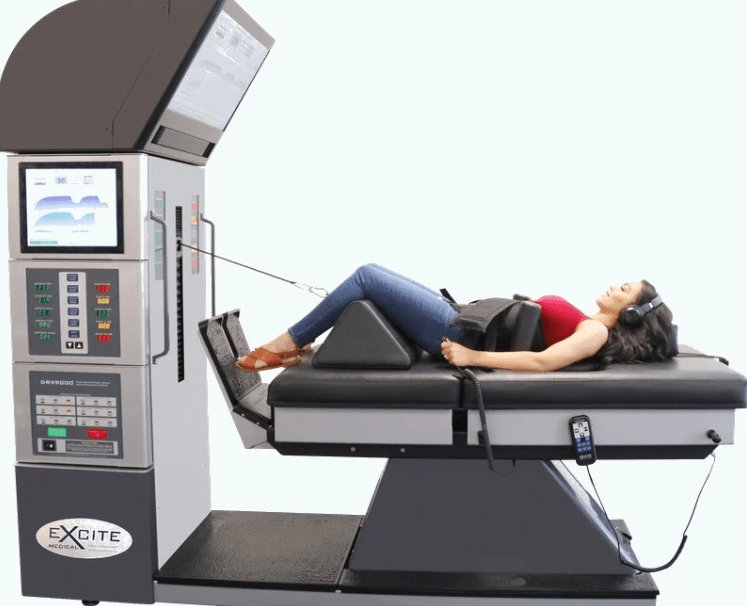
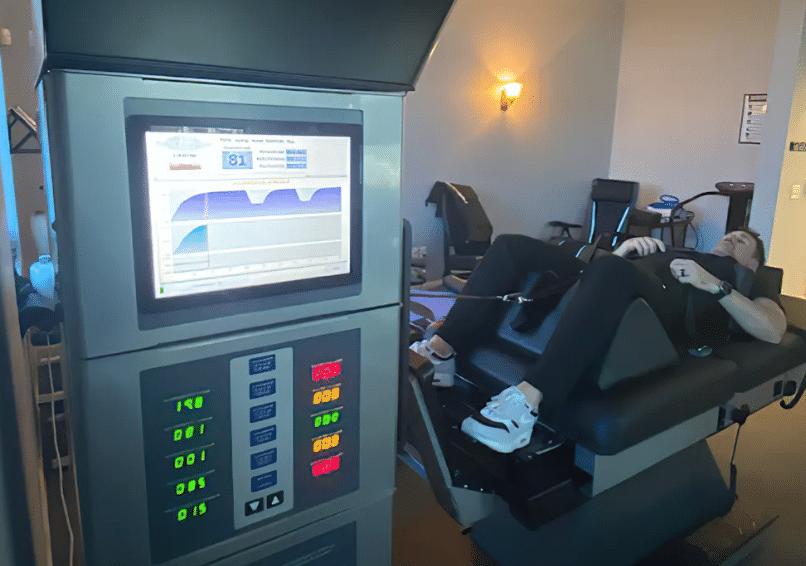
The DRX9000 is a computer-controlled spinal decompression system. We use multiple DRX9000 units in our Frisco clinic for lumbar and cervical cases. The system allows controlled, programmed traction to be applied to a selected region of the spine rather than simply applying a general stretch.
The treatment rationale is mechanical: change the loading environment around selected spinal structures and reduce pressure associated with certain disc and nerve-related problems. That is different from saying that a machine can “fix” every bad disc. It cannot. Patient selection matters.
We tend to think about decompression when the clinical picture suggests a disc or nerve-related component and the patient is an appropriate candidate for conservative care. Herniated or bulging discs, sciatica, pinched nerves, degenerative disc changes, and selected cases involving stenosis are among the conditions we evaluate.
Patients sometimes ask why they cannot get the same result by hanging from a bar, using an inversion table, or receiving ordinary traction. Those approaches can also unload the spine to some degree. The distinction is control.
With the DRX9000, treatment parameters are programmed and can be adjusted to the patient and spinal region being treated. That gives the provider considerably more control over the treatment session. Whether that additional control makes DRX9000 appropriate for a particular patient still depends on the diagnosis and clinical findings.
When an MRI is available, we may look at the level and location of a disc bulge or herniation, narrowing around a nerve, degenerative changes, and the location and severity of stenosis. But we do not treat an MRI image in isolation.
This is important because plenty of people have disc bulges and degenerative changes without having significant pain. The imaging needs to make sense in the context of the patient’s symptoms and examination. A dramatic-looking MRI finding that does not match the clinical picture may be less important than a more subtle finding that matches it very well.
Sometimes a painful episode settles because inflammation decreases, activity changes, or the irritated area simply gets a period of relative rest. Then normal life resumes. Sitting for hours, repeated bending, lifting, travel, golf, yard work, or a return to training may expose the same underlying problem again.
That is why our goal is not simply to get someone through today’s painful episode. When possible, we want to identify the pattern that keeps reproducing the problem and address the factors we can actually change.
If we use DRX9000 spinal decompression, we do not automatically assume the table is the entire treatment plan. Depending on the case, we may also address mobility, strength, muscular tension, movement habits, and activities that repeatedly aggravate the spine.
Some patients need more emphasis on rehabilitation. Others have a predominantly disc-related presentation where decompression plays a larger role. And some patients should not receive decompression at all. The plan should follow the patient, not the equipment.
We start with the history: where the pain is located, whether it travels, what makes it better or worse, how long it has been happening, and whether there are neurological symptoms. We then examine the patient and review existing imaging when it is clinically relevant.
If the findings suggest that DRX9000 spinal decompression is a reasonable option, we can discuss how it would fit into the overall plan. If the findings point somewhere else, we would rather recognize that before starting a decompression program.
Not every case belongs in a decompression program. New or progressive significant weakness, loss of bladder or bowel control, numbness in the saddle region, major trauma, or other concerning neurological changes require prompt medical evaluation. Certain fractures, unstable spinal conditions, severe osteoporosis, some infections or cancers, pregnancy, recent surgery, and other circumstances can also affect whether decompression is appropriate.
Patients understandably want to know whether DRX9000 works. We think the better question is whether it makes sense for the particular problem in front of us.
A treatment can be useful for one patient and completely wrong for another patient who describes similar pain. That is why we put so much emphasis on figuring out what is likely driving the symptoms before deciding what to do about them.
Spinal decompression may be considered for selected patients with disc-related conditions. The decision depends on the patient’s symptoms, examination, health history, imaging when relevant, and other clinical factors. Results vary.
Some cases of sciatica are related to lumbar disc or nerve-root irritation. When the clinical findings support a condition that may respond to decompression, DRX9000 may be considered as part of conservative care.
They all involve some form of spinal unloading or traction, but DRX9000 uses computer-controlled, programmable treatment parameters. The clinical significance of that control still depends on appropriate patient selection.
Not every patient automatically needs new imaging. Existing imaging can be very useful in some cases, particularly when symptoms and examination findings suggest a disc or nerve-related problem.
Session length and the overall treatment schedule depend on the patient’s condition and treatment plan. We determine recommendations after evaluating the individual case.
Symptoms can settle while contributing mechanical, neurological, activity, or movement factors remain. Recurring pain is one reason we look for patterns rather than treating every flare-up as an isolated event.
If your back pain keeps returning – particularly if it is associated with a known disc problem, sciatica, radiating leg pain, numbness, tingling, or a pinched nerve – an evaluation can help determine what may be contributing.
Frisco Spinal Rehab has treated spine and disc-related conditions in Frisco for approximately 25 years and uses multiple DRX9000 systems for spinal decompression. The objective is not to put everyone on a decompression table. It is to determine who is likely to be an appropriate candidate – and who is not.