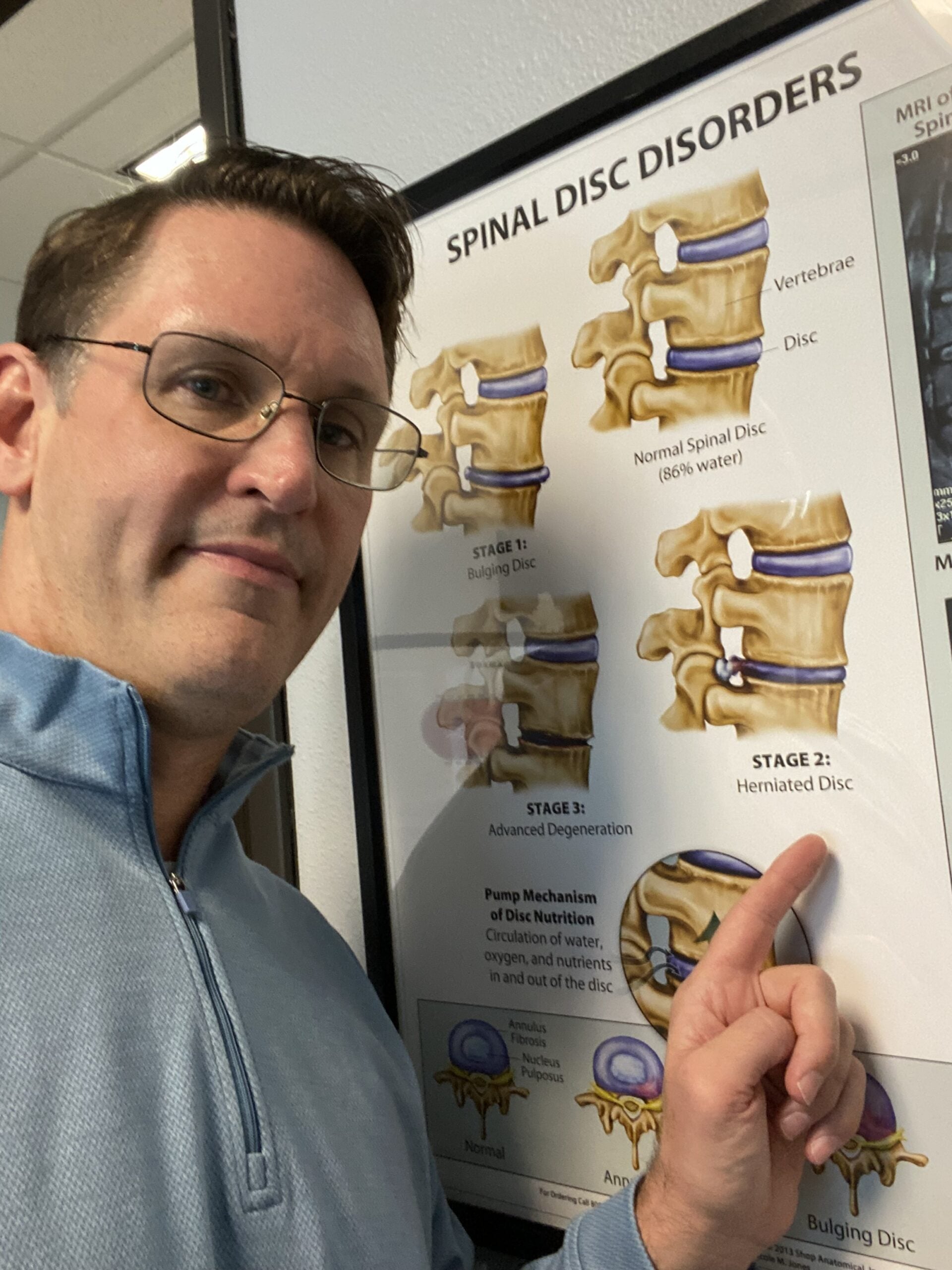
Being told you have a bulging disc can sound alarming. We regularly meet patients who have seen the words “disc bulge” on an MRI and assume they have finally found the explanation for their back pain, leg pain, neck pain, or arm symptoms.
Sometimes they have. Sometimes they haven’t.
After approximately 25 years of treating spine and disc-related conditions in Frisco, one of the most important things we can tell patients is that an MRI finding and a diagnosis are not quite the same thing. Bulging discs are common. The real question is whether the disc finding matches what the patient is actually experiencing.
That distinction matters because treatment should be directed at the problem producing the symptoms—not simply at the most noticeable phrase in an MRI report.
The discs between the vertebrae help distribute load and allow the spine to move. A disc has a tough outer portion surrounding a softer, gel-like center. With aging, repetitive loading, injury, genetics, and other factors, a disc can change shape and extend beyond its usual boundary.
That is commonly described as a disc bulge. A bulge is not automatically an emergency, and it does not automatically require treatment. Many disc changes exist without causing meaningful symptoms.
A bulging disc becomes more interesting clinically when its location corresponds with the patient’s pain pattern, neurological findings, and examination.
When we review an MRI, we do not stop when we find the words “disc bulge.” We look at where the bulge is located, which spinal level is involved, whether there is narrowing around a nerve, the condition of the surrounding discs and joints, and whether stenosis or other findings are present.
Then we compare those findings with the patient in front of us.
If an MRI shows a finding on the left but the patient’s symptoms consistently follow a right-sided nerve pattern, for example, we have to ask whether that MRI finding really explains the complaint. Conversely, a finding that lines up closely with the location of pain, numbness, tingling, weakness, and examination findings deserves more attention.
This clinical correlation is one reason we prefer to evaluate the patient rather than treating an MRI report.
There is no single “bulging disc symptom.” A lumbar disc problem can produce localized lower-back pain, but it may also irritate a nerve root and create pain into the buttock, hip, thigh, lower leg, or foot. Tingling, numbness, or weakness can occur when neurological structures are involved.
A cervical disc problem can behave differently. Symptoms may remain in the neck or extend toward the shoulder blade, shoulder, arm, hand, or fingers.
We also pay attention to behavior. Does sitting aggravate the symptoms? What happens with bending? Does coughing or sneezing change the pain? Are symptoms worse after driving? Does walking help or hurt? These details can be as useful as simply asking the patient to rate pain from zero to ten.
Patients often use “bulging disc” and “herniated disc” interchangeably, but they describe different patterns of disc displacement. A bulge generally involves a broader portion of the disc circumference, while a herniation is more focal.
For the patient, however, terminology is only part of the picture. A relatively modest-looking disc finding can be very symptomatic if it affects a nerve in the wrong place, while a larger abnormality can sometimes be surprisingly quiet. Again, the anatomy has to be interpreted alongside the symptoms and examination.
When we believe a patient’s symptoms have a disc-related mechanical component and the patient is an appropriate candidate for conservative treatment, DRX9000 spinal decompression may be one option.
Frisco Spinal Rehab uses multiple DRX9000 systems for lumbar and cervical decompression. The DRX9000 applies computer-controlled, programmed traction to the selected spinal region. The objective is to alter mechanical loading around targeted spinal structures and reduce pressure associated with certain disc and nerve-related conditions.
That does not mean the machine “puts every disc back in place,” nor do we tell every patient with a bulge that decompression is the answer. The value of decompression depends heavily on selecting the right patient.
Inversion and conventional traction can unload the spine, and some people find them comfortable. DRX9000 treatment gives the provider more control over how decompressive force is delivered and allows treatment parameters to be programmed for the region being addressed.
We consider that control useful, but equipment alone does not create a good treatment plan. A sophisticated decompression table used on the wrong patient is still the wrong treatment.
Patients sometimes arrive focused on one objective: “I need you to fix this bulging disc.” We understand the instinct, but our clinical goals are broader.
We want to know whether the disc is actually contributing to the symptoms. If it is, we consider ways to reduce mechanical irritation while also addressing movement, strength, muscular factors, and activities that may repeatedly aggravate the spine.
For one patient, decompression may be an important part of that plan. Another may need more emphasis on exercise or hands-on care. A third may need a medical or surgical opinion instead. We would rather make that distinction at the beginning than force everyone into the same protocol.
The evaluation starts with the story. Where are the symptoms? When did they begin? Do they travel? What positions make them better or worse? Is there numbness, tingling, or weakness? What has already been tried?
We then examine the patient and review existing imaging when clinically relevant. The purpose is to see whether the history, examination, and imaging tell a coherent story.
If they point toward a disc or nerve-related condition that may be appropriate for decompression, we can discuss DRX9000 treatment and the rest of the rehabilitation plan. If they do not, we look for a better explanation.
Most disc bulges do not constitute a medical emergency. Certain neurological symptoms, however, change the situation.
New or progressive significant weakness, loss of bladder or bowel control, numbness in the saddle region, major balance changes, or other significant neurological deterioration requires prompt medical evaluation. Significant trauma and certain other medical circumstances can also change the appropriate course of care.
Conservative treatment should never delay necessary medical or surgical evaluation.
Disc-related symptoms can improve over time in some people, but the course varies. Symptom improvement also does not necessarily mean that every structural MRI finding has disappeared.
Yes. When a lumbar disc affects or irritates a nerve root associated with the sciatic nerve, symptoms can extend into the buttock and leg. Sciatica has other possible causes as well, so evaluation matters.
No. Disc bulges can exist without causing symptoms. Treatment decisions should be based on the clinical picture rather than the MRI wording alone.
DRX9000 spinal decompression may be considered for selected patients whose symptoms and findings suggest an appropriate disc or nerve-related condition. It is not appropriate for every bulging disc, and individual results vary.
Not every patient automatically needs new imaging, but MRI findings can be particularly useful in some disc and neurological presentations. Existing imaging should be interpreted together with symptoms and examination findings.
It can when the disc affects a nearby nerve, although numbness and weakness have other possible causes. New or progressive significant weakness warrants timely medical evaluation.
If an MRI says you have a bulging disc—or your symptoms suggest a disc or nerve problem—the most useful first step is figuring out whether that finding actually explains what you are feeling.
Frisco Spinal Rehab has treated spine and disc-related conditions in Frisco for approximately 25 years and uses multiple DRX9000 systems for lumbar and cervical spinal decompression. Our goal is not to treat every MRI finding. It is to identify the patients for whom decompression and conservative spine care make clinical sense, and recognize when they do not.


