Back pain, neck pain, sciatica, and disc-related symptoms can interfere with sitting, walking, working, exercising, and sleeping. For some patients, surgery is necessary. For others, a carefully selected non-surgical approach may be reasonable before moving to more invasive treatment.
At Frisco Spinal Rehab, spinal decompression is not a new service we recently added. We have treated spine and disc-related conditions in Frisco for approximately 25 years and use multiple DRX9000 systems for lumbar and cervical spinal decompression. That experience has also taught us an important point: DRX9000 decompression is not appropriate for every person with back or neck pain. Determining what is causing the symptoms comes first.
Our goal is to identify the spinal region and structures most likely contributing to a patient’s symptoms, determine whether decompression is appropriate, and then integrate it with other rehabilitation when indicated.
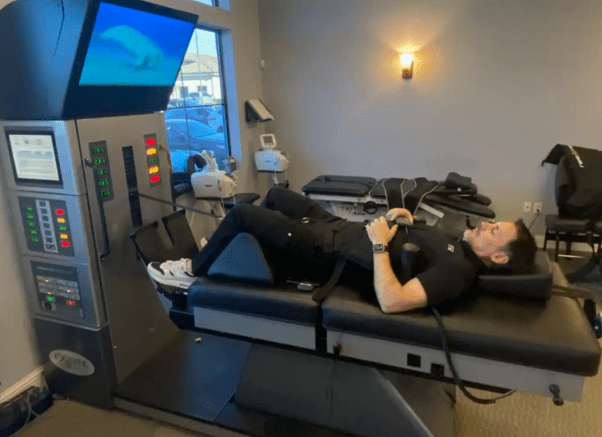
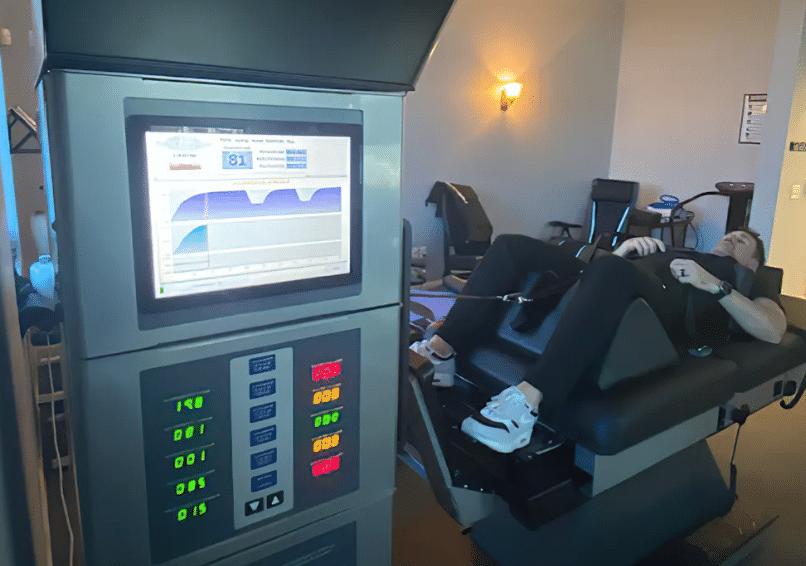
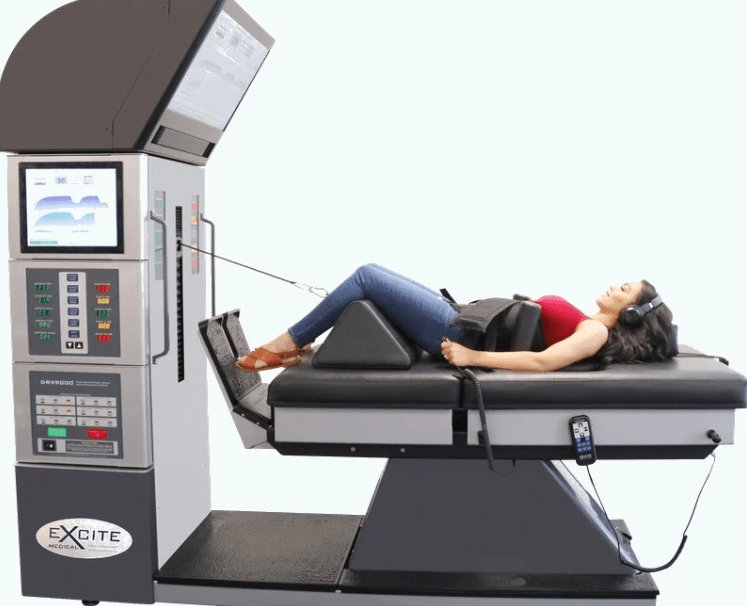
The DRX9000 is a computer-controlled spinal decompression system designed to apply programmed, controlled traction forces to a selected region of the spine. During treatment, the patient is positioned on the table and the provider selects treatment parameters based on the region being addressed and the individual case.
The purpose is not simply to ‘stretch the back.’ The clinical rationale is to alter mechanical loading in the targeted spinal area and reduce pressure associated with certain disc and nerve-related conditions. Treatment settings can be adjusted according to the patient’s condition, comfort, and response.
Traditional traction and inversion can apply a more general pulling force. The DRX9000 allows the provider to use computer-controlled, programmable decompression directed toward a selected spinal region. This ability to individualize treatment is one reason we use DRX9000 technology as part of our decompression program.
No decompression machine can guarantee a result, and the name of the equipment does not replace diagnosis or clinical judgment. The value of the technology depends on selecting an appropriate patient, identifying the area being treated, using appropriate parameters, and reassessing the patient’s response.
Spinal decompression is most relevant when symptoms appear to have a mechanical disc or nerve-related component. Conditions we commonly evaluate include the following.
A disc herniation can irritate or compress a nearby nerve root. Depending on its location, symptoms may include localized pain, radiating pain, numbness, tingling, or weakness.
A bulging disc does not automatically cause pain, but a bulge that corresponds with the patient’s symptoms and examination findings may be clinically relevant.
Lumbar disc and nerve-root irritation can produce pain extending through the buttock, hip, thigh, leg, or foot. The location of symptoms can help identify which structures should be evaluated.
Nerve irritation or compression can occur for several reasons, including disc changes and narrowing around the nerve. The underlying cause matters when deciding whether decompression is appropriate.
Age-related or degenerative disc changes can alter spinal mechanics. Treatment decisions depend on the patient’s symptoms and overall clinical picture rather than an imaging label alone.
Spinal stenosis has multiple causes and degrees of severity. Some presentations may be considered for conservative care, while significant or progressive neurological findings require appropriate medical evaluation.
Disc and nerve problems in the cervical spine can cause neck pain as well as symptoms into the shoulder, arm, hand, or fingers. We use cervical decompression for appropriately selected cases.
Two people can both describe ‘low back pain’ and have very different problems. One may have primarily muscular pain, another a symptomatic disc herniation, and another significant stenosis or another condition requiring a different approach. That is why we do not recommend DRX9000 treatment simply because someone reports back pain.
Symptoms, health history, examination findings, neurological findings, functional limitations, and available imaging all contribute to the decision. When findings suggest that decompression is unlikely to be appropriate, another treatment approach or medical referral may make more sense.
Imaging can provide useful structural information, particularly in patients with persistent or radiating symptoms. When an MRI is available, we may look for findings such as the location and level of a disc herniation or bulge, foraminal narrowing, nerve-root involvement, degenerative disc changes, and the location and degree of stenosis.
An MRI finding by itself does not prove that it is the source of pain. Disc bulges and degenerative changes can also be present in people without significant symptoms. The important question is whether the imaging findings make sense when compared with the patient’s symptoms and examination.
Decompression addresses the mechanical component of care, but spine rehabilitation often involves more than what happens on the table. Depending on the patient, treatment may also address mobility, strength, muscular tension, movement habits, and activities that repeatedly aggravate the affected area.
Our approach is therefore not based on using one modality for every patient. The goal is to combine the treatments that make sense for the specific diagnosis and then modify the plan according to progress.
DRX9000 spinal decompression is not suitable for every spinal condition. Certain fractures, unstable conditions, severe osteoporosis, some infections or cancers, pregnancy, recent surgery, and other clinical circumstances can change whether decompression is appropriate. A complete evaluation is important before treatment.
Symptoms such as new or progressive significant weakness, loss of bladder or bowel control, saddle-area numbness, or other major neurological changes require prompt medical evaluation rather than simply beginning a decompression program.
Does DRX9000 work for herniated discs?
DRX9000 decompression is used as a conservative treatment option for selected patients with disc-related conditions, including herniated discs. Whether it is appropriate depends on the location and severity of the problem, symptoms, examination findings, medical history, and other clinical factors. Results vary.
Is DRX9000 the same as ordinary traction?
Both involve traction-based forces, but the DRX9000 is a computer-controlled system that allows programmed treatment parameters and targeted use as part of a clinical decompression protocol.
Can spinal decompression help sciatica?
Some cases of sciatica are associated with lumbar disc or nerve-root irritation. When the clinical findings indicate a condition that may respond to decompression, DRX9000 may be considered as part of conservative care.
Can DRX9000 be used for neck and cervical disc problems?
Yes. Cervical spinal decompression can be used for appropriately selected cervical disc and nerve-related conditions. The cervical spine requires a different setup from lumbar decompression.
Do I need an MRI before spinal decompression?
Not every patient necessarily requires new imaging before conservative care, but imaging can be important in some cases. Existing MRI findings can also help the provider correlate structural findings with symptoms and examination results.
How many DRX9000 treatments will I need?
Treatment frequency and duration vary according to the diagnosis, severity, response to care, and individual treatment plan. We do not assume that every patient requires the same number of visits.
Does spinal decompression hurt?
Treatment is intended to provide controlled decompressive force, and settings can be adjusted according to the patient’s condition and comfort. Patients should communicate any significant increase or change in symptoms during treatment.
Who should not receive spinal decompression?
Certain medical and spinal conditions can make decompression inappropriate. This is one reason an evaluation and review of relevant health history are necessary before beginning care.
If you are dealing with a herniated or bulging disc, sciatica, radiating arm or leg pain, a pinched nerve, or persistent disc-related back or neck pain, the first question is not simply whether DRX9000 is ‘good.’ The more useful question is whether your particular condition is a reasonable match for decompression.
Frisco Spinal Rehab has treated spine and disc-related conditions in Frisco for approximately 25 years and uses multiple DRX9000 systems for lumbar and cervical spinal decompression. Schedule an evaluation to review your symptoms, clinical findings, and available imaging and determine whether decompression belongs in your treatment plan.