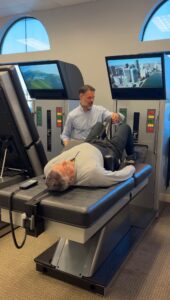
If you’re considering spinal decompression, you probably have questions that feel bigger than the treatment itself.
“Why isn’t it covered by insurance?”
“It’s expensive… what if it doesn’t work?”
“Am I being sold something?”
Those are real concerns.
And if you’re dealing with daily back or leg pain — sciatica, a herniated disc, degenerative changes — you’re not just evaluating a therapy.
You’re evaluating hope.
“Most people who call us aren’t excited about decompression. They’re exhausted. They’ve already tried rest, PT, chiropractic, and injections. They don’t want surgery — but they don’t want to stay stuck either.”
Is DRX9000 worth it?
For many patients with disc-related pain, it represents the last conservative option before injections or surgery.
Why isn’t spinal decompression covered by insurance?
Insurance coverage is based on billing structure, not always on treatment effectiveness.
What if DRX9000 doesn’t work?
Completing a structured program provides clarity before moving toward more invasive procedures.
Let’s address the objections head-on.
This is one of the most common reactions.
Insurance coverage does not determine whether something works. It determines whether it fits into their reimbursement model.
Insurance companies prefer:
Short visits
Low-cost procedures
Standardized billing codes
Predictable reimbursement
Non-surgical spinal decompression takes:
20–30 minute sessions
Multiple weeks of care
Customized protocols
Specialized equipment
It doesn’t fit neatly into their structure.
But here’s the deeper emotional layer:
If insurance covered it tomorrow, would that suddenly make it effective?
Or would it just make it easier to say yes?
This is where people feel torn.
You’re already paying:
With sleep
With missed activities
With mood changes
With patience
With fear
The real question isn’t “Is it expensive?”
It’s:
What is the cost of staying the same?
Compare the typical progression of care for disc-related pain:
Rest
Activity modification
Home remedies (heat, ice, topicals)
Over-the-counter medications
Stretching & exercise
Physical therapy
Spinal decompression
Injections
Conservative surgery
360° fusion or major reconstructive procedures
Every step down that list increases:
Invasiveness
Risk
Cost
Recovery time
Irreversibility
DRX9000 decompression sits near the end of conservative care, just before needles and scalpels enter the conversation.
It’s not the cheapest option.
But it’s far less costly — financially and physically — than surgery.
This is the one that keeps people up at night.
What if you commit the time…
Spend the money…
Get your hopes up…
And it doesn’t change anything?
Here’s the honest answer:
If you complete a proper, structured decompression program and it does not help — you’ve gained something extremely valuable.
Clarity.
You will know that you followed the correct order:
You tried rest.
You modified activity.
You did home care.
You tried PT.
You tried chiropractic.
You gave decompression a legitimate chance.
You didn’t skip steps.
You didn’t jump to surgery out of fear.
You didn’t wonder “what if?”
You moved from the most conservative to the most aggressive, in a rational progression.
And if you eventually decide to move toward injections or surgery, you do so with confidence — not regret.
That peace of mind matters.
“Who Should Not Do DRX?”
DRX may not be appropriate if:
• There is severe instability
• Progressive neurological loss
• Fracture or advanced structural collapse
Surgery has a role. There are cases where it’s necessary.
But surgery is:
Permanent
Structurally altering
Risk-bearing
Recovery-intensive
Spinal decompression is:
Non-invasive
Drug-free
Designed to reduce disc pressure
Aimed at helping the body heal
You can’t “undo” a fusion.
You can try decompression.
Most people aren’t afraid of the cost.
They’re afraid of:
Being disappointed again
Feeling foolish
Wasting time
Losing hope
When you’ve lived with pain long enough, hope feels fragile.
That’s why the key isn’t just “trying it.”
It’s doing enough of it to know for sure whether it works for you.
Not 3 visits.
Not guessing.
A structured, complete program.
Because halfway attempts create halfway clarity.
If your spine could talk, it would likely say:
“Before you cut me, inject me, or fuse me…
Have you truly tried everything that allows me to heal first?”
Spinal decompression isn’t magic.
But for the right patient, in the right situation, it can be a powerful final step before moving into more aggressive territory.
And even when it doesn’t deliver the outcome someone hoped for, it delivers certainty.
Sometimes certainty is the most valuable outcome of all.
Ask yourself:
Have I truly exhausted conservative options?
Would I regret not trying this before surgery?
Am I making a decision from fear — or from strategy?
There’s strength in moving step by step.
From least invasive…
To most invasive.
From reversible…
To permanent.
If you’d like help determining whether you’re a candidate for DRX9000 spinal decompression, we can walk through your MRI, symptoms, and history together and help you decide where you are in that progression.
You don’t have to guess.
And you don’t have to rush.
But you deserve to move forward with clarity — not fear.


