At Frisco Spinal Rehab, we use two very different forms of photobiomodulation.
One is the ARRC ATP whole-body light bed.
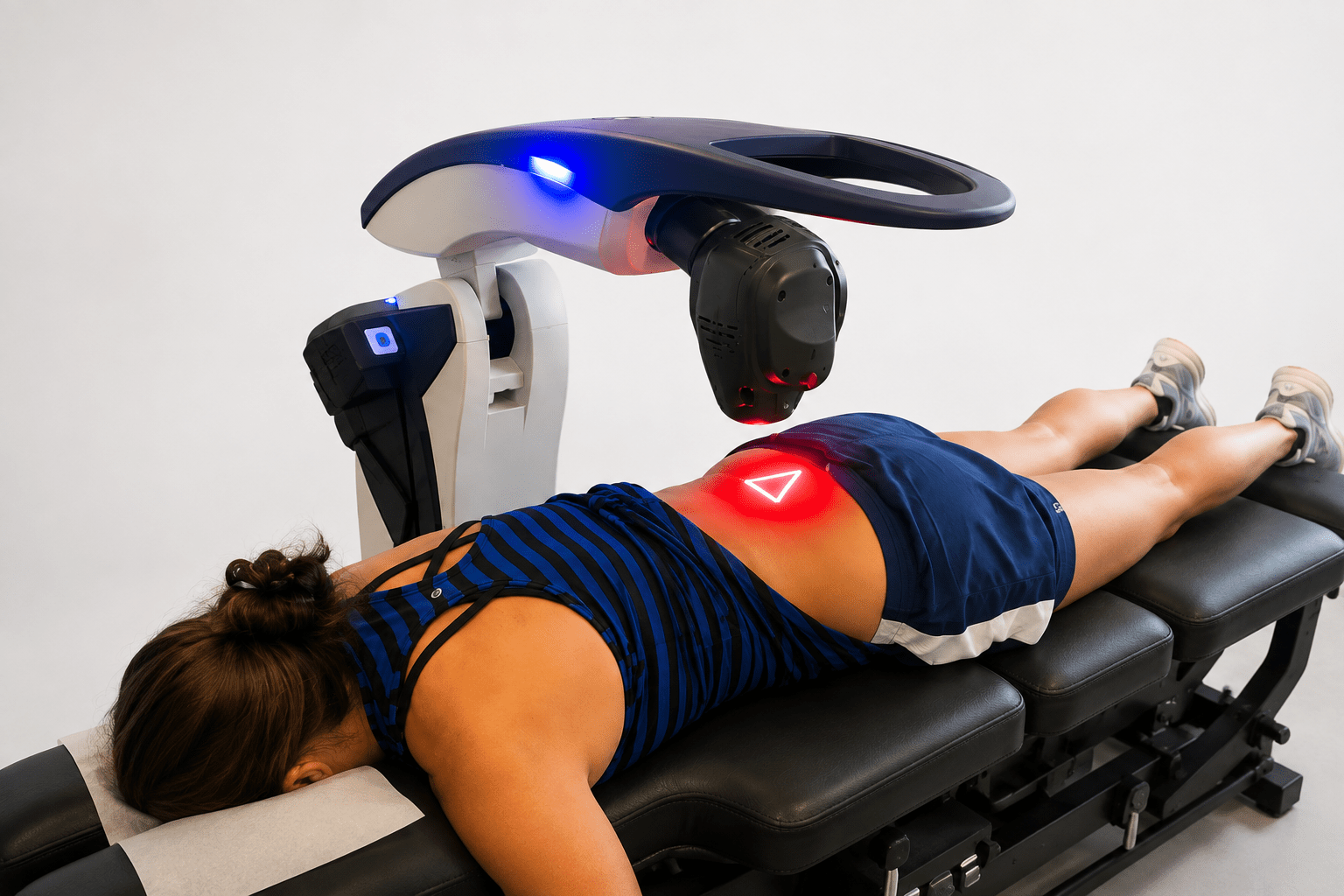
The other is the MLS M6 robotic laser.
At first glance, these technologies may seem to be doing essentially the same thing. Both expose the body to therapeutic wavelengths of red and near-infrared light with the goal of influencing cellular biology.
But philosophically, they approach the patient from almost opposite directions.
One asks:
What happens if we expose a large portion of the body to therapeutic light and try to improve the biological environment in which healing takes place?
The other asks:
What happens if we concentrate photobiomodulation directly over the painful, inflamed or injured area?
We think of these as the whole-body approach versus the targeted approach.
Or, philosophically, something resembling a vitalistic approach versus a reductionist approach.
Neither philosophy has been proven superior. In fact, science is still working out exactly how much of photobiomodulation’s effects are local and how much may occur through broader signaling throughout the body.
But the distinction is fascinating.
Photobiomodulation, commonly abbreviated PBM, describes the use of red or near-infrared light to influence biological activity without intentionally heating or damaging tissue.
When appropriate wavelengths of light interact with cells, researchers have observed changes involving mitochondrial function, ATP production, nitric oxide, reactive oxygen species and downstream cellular signaling.
Those initial events can influence transcription factors, inflammatory mediators, growth factors and other biological processes.
In other words, the photon doesn’t necessarily have to perform the entire therapeutic job itself.
Light can act as a signal.
A 2023 review of photobiomodulation described effects occurring at molecular, cellular and even systemic levels, including modulation of inflammation, tissue repair, edema and pain.
That distinction becomes important when comparing whole-body light therapy with a targeted therapeutic laser.
MLS Laser Therapy vs. Red Light Therapy: What’s the Difference?”
| MLS® Laser Therapy | ARRC Red-Light Therapy | |
|---|---|---|
| Approach | Targeted | Whole-body |
| Treatment area | Specific painful/injured areas | Large portion of the body |
| Purpose | Localized treatment | Broader PBM exposure |
| Delivery | Robotic laser | Whole-body light bed |
| Best conceptual fit | “Treat the problem area” | “Support the body’s overall recovery environment” |
| Can they be combined? | Yes, potentially | Yes, potentially |
The ARRC ATP bed exposes a very large portion of the body to red and near-infrared light simultaneously.
That creates an interesting philosophical difference.
Imagine a patient with a degenerative L4-L5 disc.
A purely localized approach might ask:
How do we get therapeutic energy into L4-L5?
The whole-body approach asks a broader question:
Can we improve the overall biological environment of the person who is trying to heal?
That is a much more vitalistic way of thinking about treatment.
The ARRC isn’t trying to identify one square inch of painful tissue and bombard only that location.
Instead, a very large surface area of the body is exposed to photobiomodulating wavelengths.
Potential PBM effects discussed in the scientific literature include changes in mitochondrial activity, cellular energy metabolism, nitric-oxide signaling, inflammatory signaling and tissue-repair pathways.
There is also an emerging field studying systemic photobiomodulation.
Researchers have reported that biological effects of PBM are not necessarily limited to the exact tissue directly exposed to light. Experimental research has investigated possible systemic effects involving circulating signaling molecules, immune modulation, vascular responses and other mechanisms.
That leads to an intriguing hypothesis.
Perhaps every photon doesn’t need to reach an injured structure for PBM to influence the body’s response to injury.
This is where we need to distinguish an interesting hypothesis from an established medical fact.
Intervertebral discs are challenging structures to treat biologically.
They have limited direct blood supply and are located relatively deep within the body.
We do not have evidence showing that an ARRC ATP bed regenerates a degenerative lumbar disc.
We also don’t know whether a meaningful amount of light from a whole-body PBM bed reaches the nucleus pulposus of a deep L4-L5 or L5-S1 disc.
But that doesn’t necessarily mean the only possible biological effect would require photons to reach the disc directly.
Research into systemic photobiomodulation suggests that light applied to one part of the body can, under some experimental conditions, produce biological effects elsewhere.
Proposed mechanisms include changes involving inflammatory signaling, immune cells, circulating mediators, vascular responses and cellular communication.
This remains an emerging area of research, and it would be premature to claim that these systemic effects cause damaged human discs to heal.
But conceptually, this is what makes whole-body PBM interesting.
Instead of asking only whether light reaches the disc, we can also ask whether whole-body PBM might influence the biological environment surrounding recovery.
That question has not yet been adequately answered.
The MLS M6 robotic laser represents a much more targeted philosophy.
Instead of treating most of the body, we identify the symptomatic region and deliver photobiomodulation directly over it.
For example:
A patient has an L5-S1 disc herniation.
The disc is irritating the S1 nerve root.
The patient has pain extending through the buttock and down the leg.
With MLS, treatment can be directed specifically over the lower lumbar region and other clinically appropriate areas.
MLS uses synchronized 808-nm and 905-nm near-infrared wavelengths.
Research on MLS and photobiomodulation more broadly has investigated effects involving pain, inflammation, edema and tissue repair. MLS itself has been studied in multiple musculoskeletal conditions, although considerably more independent research is still needed to establish its comparative effectiveness.
This is the more reductionist approach:
Find the problem.
Find the painful or inflamed tissue.
Deliver the light as close to that target as possible.
There is an appealing logic to it.
If the patient’s problem is centered around L5-S1, why illuminate their entire body when we can concentrate treatment over L5-S1?
But even that apparently simple idea becomes biologically complicated.
We don’t know that an adequate therapeutic dose from an externally applied MLS treatment reaches a deep human lumbar disc.
Near-infrared light penetrates tissue better than visible red light, but penetration decreases substantially with depth as photons are absorbed and scattered.
So we should not assume:
“We put the MLS over L5-S1, therefore the nucleus pulposus received the therapeutic dose.”
That has not been demonstrated.
But something interesting happens here.
Direct penetration may not be the entire story.
Photobiomodulation isn’t simply about photons traveling until they strike the final injured structure.
When light is absorbed by responsive cells, it can initiate biological signaling.
PBM research has documented changes involving:
mitochondrial activity
ATP production
nitric oxide
reactive oxygen species
inflammatory mediators
gene expression
growth factors
and multiple downstream signaling pathways.
These initial cellular events can therefore produce secondary effects that continue after the light exposure has ended.
That raises another intriguing hypothesis.
Even if the full MLS dose does not physically penetrate all the way to the center of a lumbar disc, could irradiation of the surrounding tissues initiate biological signaling that influences the local inflammatory environment?
Possibly.
There are scientifically plausible mechanisms for this.
But once again, we need to draw the line between plausibility and proof.
There is currently no strong clinical evidence demonstrating that an MLS treatment over the lumbar spine creates a secondary cellular cascade that subsequently regenerates a deep human disc.
It’s an interesting possibility—not an established treatment mechanism.
Think about the two philosophies.
The question is:
Can we influence a huge number of cells throughout the body and potentially create a more favorable systemic environment for recovery?
That’s the broad approach.
We aren’t necessarily insisting that a large therapeutic dose physically reaches one particular disc.
We’re attempting to influence the organism in which that disc exists.
The question becomes:
Can we deliver a more concentrated photobiomodulation treatment as close as practical to the tissues involved in the patient’s symptoms?
That’s the targeted approach.
And even if every photon doesn’t reach the nucleus pulposus, perhaps effects on surrounding muscle, nerve, connective tissue, circulation and inflammatory signaling could still be clinically meaningful.
The two approaches aren’t necessarily competitors.
They may simply be asking different biological questions.
There is an old philosophical tension in healthcare.
One approach looks at the whole organism.
The other breaks a problem into smaller components and attempts to treat the specific structure or mechanism responsible.
Neither is inherently right or wrong.
Modern medicine uses both constantly.
If someone has an infected appendix, we don’t merely try to make their entire body healthier and hope the appendix improves. We identify the diseased structure and address it.
That’s reductionism at its best.
But if someone is recovering from an injury, factors such as sleep, nutrition, physical activity, metabolic health and systemic inflammation can influence recovery.
That’s the whole-person perspective.
Photobiomodulation gives us an interesting technological version of this philosophical debate.
ARRC asks us to think globally.
MLS asks us to think locally.
And biology may ultimately tell us that both perspectives matter.
This is one of the more fascinating developments in PBM research.
Scientists have observed in experimental models that irradiation of one part of the body can sometimes produce effects in tissues that were not directly irradiated.
This has been called remote photobiomodulation.
Researchers have proposed several possible explanations, including circulating signaling molecules, immune-system changes, extracellular vesicles, vascular effects and mobilization of cells involved in tissue repair.
A systematic review of experimental systemic PBM studies found evidence of effects involving circulation, metabolic conditions and tissue repair, although protocols varied dramatically and the researchers emphasized the need for much better standardization.
This doesn’t prove that lying in a whole-body light bed causes a lumbar disc to repair itself.
But it does challenge a simplistic assumption:
For light therapy to matter, every therapeutic photon must necessarily reach the injured structure directly.
The biology may be more complicated than that.
Targeted photobiomodulation has a much larger research history.
Laboratory studies have demonstrated that PBM can alter cellular gene expression and the release of cytokines and growth factors.
Modern mechanistic reviews describe effects involving mitochondrial metabolism, inflammatory pathways and downstream signaling cascades.
MLS adds another wrinkle by synchronizing two near-infrared wavelengths—808 and 905 nm—and has been investigated for pain and inflammatory conditions.
This makes the targeted strategy scientifically attractive.
Put the greatest photobiomodulation exposure close to the region where you’re trying to create an effect.
But dosage matters enormously.
More light isn’t necessarily better.
PBM demonstrates what researchers call a biphasic dose response, meaning biological effects can depend heavily on wavelength, irradiance, total energy and treatment duration.
That’s another reason we shouldn’t assume that any red-light bed and any therapeutic laser are biologically interchangeable.
This is where the research gets especially interesting.
Laboratory studies have shown that human nucleus pulposus cells—the cells from the center of the intervertebral disc—can respond to photobiomodulation.
Researchers have demonstrated changes involving inflammatory signaling and enzymes responsible for extracellular-matrix metabolism.
Animal studies have gone even further.
In experimentally degenerated discs, certain near-infrared laser treatments have been associated with changes in inflammatory markers, collagen, aggrecan and MRI characteristics.
Those experiments suggest that light can influence disc biology under certain conditions.
But they don’t establish that either an ARRC ATP bed or an MLS M6 regenerates damaged human spinal discs.
That remains an unanswered question.
We don’t necessarily think we have to choose.
The ARRC and MLS represent two different ways of applying the same broad biological phenomenon.
ARRC:
Treat a very large portion of the organism and potentially influence systemic physiology.
MLS:
Concentrate photobiomodulation around the symptomatic or injured region.
We find both approaches scientifically interesting.
But we’re also careful not to confuse what is biologically plausible with what has actually been demonstrated in controlled human trials.
For spinal-disc patients, neither technology should be described as a proven method of regenerating a damaged disc.
This creates an even more interesting distinction.
Photobiomodulation is primarily a biological intervention.
DRX9000 spinal decompression is primarily a mechanical intervention.
A patient with a disc problem potentially has both components.
There is the mechanical environment:
compression, movement, loading, disc pressure and nerve irritation.
And there is the biological environment:
inflammation, cellular metabolism, tissue response and recovery.
Our interest in combining technologies comes from addressing different pieces of that puzzle rather than assuming that one device does everything.
DRX9000 approaches the spine mechanically.
MLS approaches the symptomatic region with targeted photobiomodulation.
ARRC approaches photobiomodulation from a whole-body perspective.
Exercise ultimately restores the patient’s ability to actively load and use the spine.
That’s a much more realistic way to think about multimodal spine care than claiming any single technology “heals discs.”
Here’s the study we’d like to see.
Take patients with MRI-confirmed lumbar disc problems and randomly assign them to:
spinal decompression alone
decompression + targeted PBM
decompression + whole-body PBM
decompression + both
and ideally a well-designed rehabilitation comparison.
Measure pain and function—but don’t stop there.
Measure MRI characteristics.
Measure neurological outcomes.
Follow the patients for a year or longer.
Then we could begin answering the question scientifically.
Until studies like that exist, we should remain curious without pretending we already know the answer.
ARRC and MLS represent two fascinating but very different philosophies of photobiomodulation.
ARRC takes the whole-body approach: expose a large portion of the body to therapeutic wavelengths and potentially influence the broader biological environment in which healing occurs.
MLS takes the targeted approach: concentrate photobiomodulation over the painful or injured region in an attempt to maximize local biological effects.
Whole-body PBM might be described philosophically as more vitalistic.
Targeted MLS treatment might be described as more reductionist.
But those are philosophies—not proof of mechanism.
Science increasingly recognizes that photobiomodulation can initiate cellular signaling and that some PBM effects may extend beyond the tissue directly exposed to light.
What science has not established is that ARRC makes human spinal discs heal through systemic effects or that MLS regenerates a deep lumbar disc through direct penetration or secondary signaling.
Those remain intriguing questions.
And perhaps the most interesting possibility isn’t that one philosophy will eventually defeat the other.
It may be that recovery involves both: improving the environment of the whole organism while also directing treatment toward the tissues that need the most help.
This article is for educational purposes only. Neither ARRC whole-body photobiomodulation nor MLS laser therapy has been proven to regenerate degenerative or herniated human intervertebral discs. Treatment recommendations should be individualized based on a patient’s diagnosis, examination, symptoms and imaging when appropriate.


