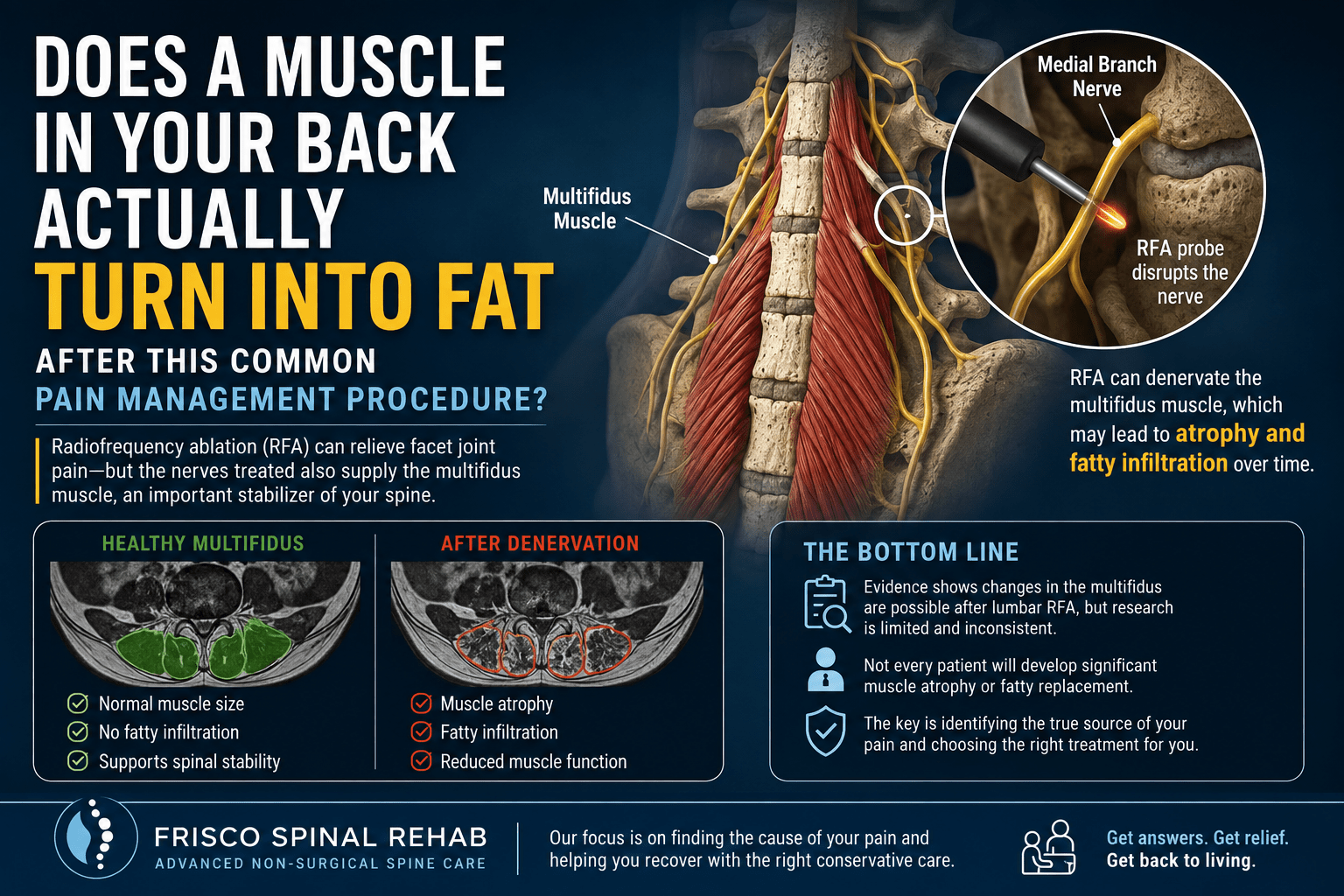
Radiofrequency ablation—also called RFA, radiofrequency neurotomy, or sometimes a rhizotomy—is a common procedure used to treat chronic low back pain believed to originate from the facet joints.
The idea is fairly straightforward: if a small nerve is carrying pain signals from an irritated facet joint, radiofrequency energy can be used to disrupt that nerve and reduce its ability to transmit pain.
For appropriately selected patients, RFA can provide meaningful pain relief. In fact, evidence-based pain-management guidelines support lumbar medial branch radiofrequency neurotomy for certain patients with facet-mediated low back pain.
But there is another part of the story that many patients have never heard about.
The nerves targeted during lumbar RFA don’t only communicate with the facet joints. They also supply an important stabilizing muscle of the spine—the multifidus.
And that raises an interesting question:
What happens to the multifidus muscle after its nerve supply is disrupted?
The multifidus is a deep muscle running along the back of the spine.
Unlike the large muscles you might associate with lifting weights, the multifidus consists of relatively small bundles of muscle that cross spinal segments. One of its important functions is helping provide segment-by-segment stability and control of the lumbar spine.
This matters because the medial branch nerves targeted during lumbar RFA also provide innervation to the multifidus muscle. This isn’t a controversial anatomical theory; it is well-established anatomy and is specifically discussed in clinical guidelines on lumbar facet interventions.
Therefore, when a medial branch nerve is intentionally treated with radiofrequency energy, denervation of at least part of the multifidus can occur as well.
Not exactly.
Muscle doesn’t literally transform into fat cells like one substance changing into another.
However, denervated muscle can undergo atrophy and can eventually develop fatty infiltration and fibrosis. On MRI, healthy functional muscle can therefore be replaced to varying degrees by non-contractile tissue, including fat.
That’s where the provocative idea that a muscle can “turn into fat” comes from.
And researchers have specifically investigated whether this happens to the multifidus following lumbar radiofrequency ablation.
The answer is fascinating—but it is also more complicated than a simple yes or no.
A 2024 systematic review published in PM&R examined studies evaluating structural or functional changes in the multifidus following lumbar radiofrequency ablation.
The researchers found evidence of multifidus changes in several studies.
Two studies evaluating muscle function reported changes consistent with dysfunction or denervation. Among four studies that evaluated the structure of the multifidus using MRI, two found decreased muscle cross-sectional area or increased fatty infiltration.
However, another study found no significant structural change, while another reported an apparent increase.
The researchers therefore concluded that multifidus atrophy or dysfunction after lumbar RFA is plausible, but emphasized that the available research is limited and the overall certainty of the evidence is very low.
A more recent review reached a similar conclusion: current evidence suggests RFA may produce structural or functional changes in the multifidus, but studies remain too inconsistent to determine precisely how often this occurs or what its long-term clinical significance may be.
In other words:
There is evidence that changes can occur. There is not enough evidence to say that every patient who undergoes RFA will develop significant multifidus atrophy or fatty replacement.
That distinction is important.
The issue comes down to anatomy.
The medial branch nerve carries sensory information from the facet joint, but it also provides motor innervation to the multifidus.
RFA intentionally interrupts that nerve.
Clinical consensus guidelines acknowledge that lumbar medial branch RFA results in denervation of the multifidus, although they also emphasize that the physiological and clinical consequences remain uncertain.
Denervation can cause a muscle to become less active. Over time, prolonged denervation can lead to progressively greater atrophy and, in some circumstances, replacement of muscle tissue with fibrous and fatty tissue.
This is particularly interesting when patients undergo repeated RFA procedures over a period of years.
The same consensus guidelines caution that denervation of paraspinal muscles can persist for more than 12 months in some patients and discuss the potential for irreversible changes when RFA is repeatedly performed too early. For that reason, the guidelines recommend waiting for pain to recur before repeating RFA rather than performing it preemptively.
No.
That would be an equally misleading conclusion.
RFA is an established pain-management procedure and can provide significant relief for appropriately selected patients with facet-mediated low back pain.
The real question is not whether RFA is “good” or “bad.”
It’s whether the potential benefits and limitations make sense for the individual patient’s specific source of pain.
A patient with primarily facet-mediated pain is very different from someone whose symptoms are primarily coming from a disc herniation, spinal stenosis, nerve-root compression or another structural problem.
RFA is intended to interrupt pain transmission from the facet joints. It does not repair a damaged disc, enlarge a narrowed neural foramen or directly remove compression from a spinal nerve.
That’s why determining the source of the pain matters.
The multifidus isn’t simply another back muscle.
It plays an important role in controlling and stabilizing individual spinal segments.
For someone with chronic back problems, we believe it makes sense to consider not only:
“How can we decrease the pain?”
but also:
“What structures are causing the pain, and what can we do to preserve or improve function?”
Those aren’t necessarily the same question.
Pain relief is extremely important. But eliminating a pain signal does not automatically mean the underlying mechanical or structural problem has changed.
There is no reason to panic.
The available research does not show that everyone who has undergone lumbar RFA develops severe multifidus degeneration.
If you’ve had RFA and it provided substantial relief, that benefit is real.
But if pain has returned, if you’ve undergone repeated procedures, or if you’re considering another RFA, it may be worthwhile to step back and evaluate the bigger picture.
Questions worth discussing with your healthcare provider include:
So, does a muscle in your back actually turn into fat after a rhizotomy?
That’s an oversimplification—but there’s a legitimate scientific issue behind the question.
The medial branch nerves treated during lumbar radiofrequency ablation also innervate the multifidus muscle. RFA can denervate that muscle, and some studies have documented multifidus dysfunction, atrophy and increased fatty infiltration afterward.
At the same time, the scientific literature is limited and inconsistent, and we cannot currently say that clinically significant multifidus degeneration occurs in every patient—or even determine precisely how frequently it occurs.
For patients considering RFA, the goal shouldn’t be fear of the procedure.
The goal should be understanding exactly what is being treated, what the procedure can and cannot accomplish, and what other structures may be affected.
At Frisco Spinal Rehab, our focus is on identifying the underlying factors contributing to a patient’s back or neck pain and determining which conservative treatment options may be appropriate for that individual.
If you’ve been told you need a rhizotomy, have already undergone radiofrequency ablation and your pain has returned, or simply want another perspective on your MRI and nonsurgical options, an evaluation can help you better understand what’s happening in your spine.
This article is for educational purposes and is not intended to diagnose a condition or replace individualized medical advice. Treatment recommendations depend on a patient’s history, examination, imaging and diagnosis.


