Neck pain can make even simple activities miserable. Looking over your shoulder while driving, working at a computer, sleeping comfortably, or picking up your child can become daily struggles.
Many people eventually find themselves searching for alternatives after medications, physical therapy, chiropractic care, injections, or even surgery fail to provide lasting relief.
One treatment that often comes up is the DRX9000 spinal decompression system.
But does it actually work?
The answer is it depends on what’s causing your neck pain.
At Frisco Spinal Rehab, we’ve treated patients with chronic neck conditions for more than 25 years. We’ve found that cervical spinal decompression can produce remarkable results for the right patient—but it’s certainly not the right treatment for everyone.
Here’s what you should know before considering it.
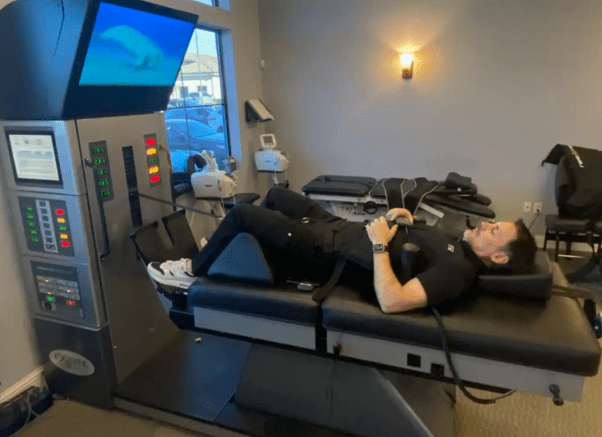
The DRX9000 is a computerized spinal decompression system designed to gently reduce pressure inside damaged cervical discs.
Unlike simply stretching your neck, the computer continually adjusts the amount of force applied throughout treatment. This helps minimize muscle guarding while precisely targeting the injured spinal level.
The goal is to:
Treatment is completely non-surgical and requires no injections or anesthesia.
Not every neck problem is caused by the same thing.
We’ve found the best candidates usually have one or more of these conditions:
Cervical Disc Herniation
A herniated cervical disc can press directly on a nerve root, causing:
Reducing pressure on that nerve is often the primary goal of decompression.
Cervical Degenerative Disc Disease
As discs lose water content with age, they become thinner and less effective at absorbing forces.
This can contribute to chronic stiffness and recurring neck pain.
Some patients experience significant improvement when decompression reduces mechanical stress on these aging discs.
Cervical Radiculopathy
“Cervical radiculopathy” simply means a pinched nerve in the neck.
Pain may travel from the neck into the shoulder, arm, forearm, or even the fingers.
Many patients are surprised to learn that arm pain often originates in the neck rather than the shoulder itself.
Foraminal Stenosis
The openings where nerves leave the spine are called foramina.
When these openings narrow, nerves can become irritated.
Depending on the cause and severity, decompression may help reduce pressure on these nerve roots.
One thing we tell patients every week:
You may not be a candidate if you have:
This is why every patient should receive a thorough history, examination, and imaging review before treatment begins.
One of the biggest surprises for first-time patients is how gentle the treatment is.
You lie comfortably on the decompression table while a specialized harness supports your head.
The machine slowly applies and releases precise traction forces according to your treatment program.
Most patients describe it as:
Treatment typically lasts about 15–20 minutes.
Every patient heals differently.
Some people notice improvement after only a few treatments.
Others require several weeks before symptoms begin improving.
Factors that influence recovery include:
Our goal isn’t simply reducing today’s pain—it’s creating lasting improvement.
Research on cervical spinal decompression is encouraging, particularly for carefully selected patients with disc-related neck pain and cervical radiculopathy.
Like many conservative treatments, results vary depending on the diagnosis and patient selection.
This is why an accurate diagnosis matters far more than simply owning a decompression machine.
Sometimes.
If your symptoms are caused by a herniated cervical disc or nerve compression—and you don’t have progressive neurological loss—conservative treatment may help enough that surgery becomes unnecessary.
However, surgery remains the best option for certain serious conditions.
A good doctor should tell you when decompression is appropriate—and when it isn’t.
DRX9000 isn’t a miracle machine.
But for properly selected patients with disc-related neck pain, cervical radiculopathy, or certain degenerative conditions, it can be an excellent non-surgical treatment option.
The key isn’t the machine itself.
The key is making the correct diagnosis and choosing the right treatment for the right patient.
That’s where experience matters.
Is DRX9000 painful?
No. Most patients describe the treatment as gentle and relaxing.
Will my insurance cover DRX9000?
Coverage varies by insurance plan. Our staff can review your benefits before treatment begins.
Can I receive chiropractic adjustments during decompression?
Often, yes. Many patients benefit from a comprehensive treatment plan that includes decompression, chiropractic care, rehabilitation exercises, and soft tissue therapy.
How many treatments will I need?
The number depends on your diagnosis, MRI findings, symptom severity, and how long you’ve had the condition.
Written by Dr. David Kaff, DC
Owner, Frisco Spinal Rehabilitation