If you’ve been told you need an injection into your disc—or you’re considering PRP, stem cells, or other regenerative treatments—you’re not alone.
But here’s the real question most patients never get answered:
👉 Do these treatments actually fix the problem inside the disc—or just temporarily reduce pain?
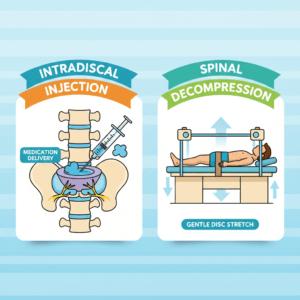
Because if the root issue isn’t addressed, symptoms often come back.
Intradiscal injections involve placing a needle directly into the spinal disc and delivering substances intended to reduce pain or promote healing.
Common types include:
PRP (Platelet-Rich Plasma)
Stem cell injections
Ozone therapy
Discogel (ethanol gel)
Steroid injections
Each has a different goal—but not all address the root cause of disc pain.
Most disc-related pain is driven by:
Increased intradiscal pressure
Bulging or herniation compressing nerves
Chemical inflammation from disc material
👉 This is a mechanical problem first, not just a biological one.
Goal: Stimulate healing inside the disc
Reality:
May help early degeneration
Limited blood flow = limited repair potential
Results vary widely
👉 Best for: mild to moderate disc damage
👉 Limitation: Does not reduce disc pressure
Goal: Shrink disc material and reduce pressure
Reality:
More mechanically logical
Some strong results internationally
Not widely used in the U.S.
👉 Best for: contained herniations
👉 Limitation: Less precise control of pressure changes
Reduce inflammation temporarily
Do not fix disc structure
👉 Best for: short-term relief only
👉 Limitation: Often temporary
Even the most advanced injections often do not correct:
Internal disc pressure
Mechanical loading of the spine
Ongoing nerve compression
👉 That’s why results can be inconsistent or temporary.
Spinal decompression focuses on the root mechanical issue:
👉 Excess pressure inside the disc
The DRX9000 works by:
Creating negative intradiscal pressure
Helping retract disc material
Improving fluid and nutrient movement into the disc
Reducing nerve compression
| Feature | Injections | Spinal Decompression |
|---|---|---|
| Targets inflammation | ✅ | ⚠️ Secondary |
| Promotes healing | ✅ (limited) | ✅ (indirect) |
| Reduces disc pressure | ❌ (most) | ✅ |
| Non-invasive | ❌ (needle into disc) | ✅ |
| Consistency of results | ⚠️ Variable | ✅ More predictable (when indicated) |
You may be a better candidate for injections if:
Early disc degeneration
Minimal structural damage
Looking for adjunct therapy
You may be a better candidate for spinal decompression if:
Herniated or bulging disc
Sciatica or radiating pain
Failed injections or persistent symptoms
You want a non-invasive approach
No needles or surgical risk
Addresses the cause, not just symptoms
Can be combined with other therapies if needed
If you’re considering injections—or have already tried them without lasting relief—it’s critical to understand what’s actually driving your pain.
At Frisco Spinal Rehab, we evaluate:
Disc condition
Nerve involvement
Mechanical loading patterns
Then determine whether decompression, injections, or another approach is best.
👉 Schedule your consultation today.
They can help certain patients, especially in early-stage disc degeneration, but results are inconsistent and often temporary if pressure inside the disc is not addressed.
Early studies are promising, but evidence is still limited and results vary significantly between patients.
For many patients with herniated discs or nerve compression, spinal decompression may provide more consistent results because it directly reduces disc pressure.
In some cases, combining therapies may be beneficial depending on the condition and severity.


