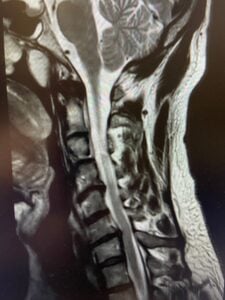
Hearing the words “herniated disc” can feel scary, especially when you first see it written on an MRI report.
Many people immediately think:
“Is my back permanently damaged?”
“Will this ever heal?”
“Is this why my leg hurts?”
These are very normal reactions. The term sounds serious, and for many people it’s the first time they’ve ever heard it.
But the truth is, a herniated disc can mean different things for different people, and the severity isn’t always what people imagine.
Between each bone in the spine is a disc that acts like a cushion. These discs help absorb shock and allow the spine to move.
A herniated disc simply means that part of that disc has pushed outward beyond where it normally sits.
This can happen from:
Years of wear and tear
Lifting injuries
Twisting movements
Gradual degeneration over time
Sometimes it happens suddenly. Other times, it develops slowly.
The discs sit very close to the nerves that travel down into the legs.
If a disc bulges or herniates in the wrong direction, it can irritate a nearby nerve. When that happens, people may feel:
Burning sensations
Tingling
Numbness
Weakness
This is why some people have more leg pain than back pain when a disc is involved.
This is the part that surprises many people.
A herniated disc can be:
Mild
Moderate
Severe
And the MRI alone doesn’t always tell the full story.
Some people have a herniated disc and feel very little pain.
Others have significant symptoms from a disc that doesn’t look dramatic on imaging.
What matters most is:
Your symptoms
How long they’ve been present
How they affect your daily life
Not just the word “herniated.”
The term “herniation” makes people think something is completely torn apart. But in many cases, it simply means part of the disc is pushing outward and irritating nearby structures.
Many people live with disc herniations and continue working, walking, and functioning.
The real concern is when it begins to:
Cause ongoing pain
Limit movement
Create leg symptoms
That’s when people start seeking answers.
Two people can have similar MRI findings and feel completely different.
One might have:
Mild stiffness
Occasional back pain
Another might have:
Constant leg pain
Trouble sitting
This is because symptoms depend on how the disc is interacting with nearby nerves and tissues, not just how it looks on the scan.
This is one of the biggest fears people have.
In reality, many people with herniated discs never need surgery.
Surgery is usually considered when there are more serious signs like:
Progressive weakness
Loss of function
Severe, unmanageable pain
Certain neurological symptoms
But many people fall into a different category — where the main issue is ongoing pain and quality of life, not an emergency situation.
A common pattern with herniated discs is:
Flare-ups
Improvement
Then symptoms return again later
This can happen because the area becomes irritated, then calms down, then gets irritated again with daily life.
People often notice symptoms triggered by:
Sitting too long
Driving
Bending
Lifting
Getting out of bed
This doesn’t mean the situation is getting worse — but it can mean the area is still sensitive.
Many people with a herniated disc go through a long journey:
Physical therapy
Medications
Sometimes these help.
Sometimes they help briefly.
Sometimes they don’t help at all.
At that point, people often start asking deeper questions about what’s really going on.
At Frisco Spinal Rehab, we often meet patients who come in worried after seeing “herniated disc” on their MRI. For many, the biggest fear is what it means for their future.
In a lot of cases, the disc finding helps explain why they’ve been having back pain, leg pain, or recurring flare-ups. Understanding how that disc is affecting nearby nerves and movement can help make sense of the symptoms they’ve been dealing with.
Every case is different, and the level of concern depends more on how it’s affecting your life than the word itself on the report.
A herniated disc can sound alarming, but it doesn’t always mean something severe or permanent. For many people, it’s simply one piece of the puzzle that helps explain ongoing back or leg symptoms.
The most important factors are how you feel, how long symptoms have lasted, and how much they affect your daily life. Understanding the bigger picture can help you make sense of what the MRI means — and what steps might make the most sense moving forward.


