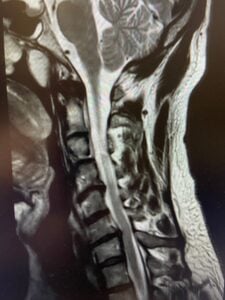
Few phrases on an MRI report worry patients more than “degenerative disc disease.”
People often react immediately with fear:
“Do I have a disease?”
“Is my spine breaking down?”
“Is this going to keep getting worse?”
“Am I going to end up needing surgery?”
The name itself sounds serious and permanent. But in reality, the term is often misunderstood and can mean different things depending on the person and the situation.
This is one of the most important things to understand.
Despite the name, degenerative disc disease isn’t an illness or infection. It’s a medical term used to describe changes in the discs of the spine that happen over time.
As we age, discs can:
Lose some hydration
Become thinner
Become less flexible
These changes are very common and can be seen on MRIs in people who have no pain at all.
Discs sit between the bones in the spine and act like cushions. They help:
Absorb shock
Allow movement
Support daily activity
Over the years, normal wear and tear can change how these discs look on imaging. That’s what the term “degeneration” is referring to.
The phrase “degenerative disc disease” makes many people feel like their spine is:
Crumbling
Wearing out rapidly
Permanently damaged
But in many cases, it simply means the discs are showing signs of normal aging.
Some people in their 30s have early changes.
Many people in their 40s and 50s have them.
By 60+, it’s extremely common.
And many have no symptoms at all.
Even though these changes are common, they can sometimes contribute to:
Back stiffness
Recurring flare-ups
Pressure-related pain
Sensitivity with sitting or bending
This happens when the discs are less able to handle daily stress, which can make the surrounding structures work harder.
In some cases, disc changes may also be present alongside:
That’s when people may start noticing leg pain or nerve-related symptoms.
Two people can have very similar MRI reports that say “degenerative disc disease” and feel completely different.
One might have:
Mild stiffness
Occasional soreness
Another might have:
Recurring flare-ups
Trouble sitting or standing long
This is because the MRI shows structure — but symptoms depend on how the spine is functioning and how sensitive the area has become.
People with disc degeneration often notice a pattern:
Pain flares up
It settles down
Life goes back to normal
Then it returns later
This can happen because the area may become irritated during certain activities like:
Sitting too long
Lifting
Travel
Bending
Long workdays
When the irritation calms, the pain improves. But if the stress builds again, symptoms can return.
Not necessarily.
Many people worry that seeing “degenerative” on an MRI means things will rapidly decline. But that’s not always the case.
For many, these changes:
Progress slowly
Stabilize
Or stay about the same for years
Symptoms often depend more on daily strain, posture, and activity levels than on the imaging alone.
Because these changes are so common, the phrase “degenerative disc disease” appears frequently in imaging results.
It can be surprising how many people have disc changes without knowing it.
That’s why the most important part isn’t just what the MRI says — it’s how your symptoms match up with what you’re feeling day to day.
Many people first see this term after:
Months or years of recurring back pain
Failed physical therapy
Ongoing stiffness and flare-ups
At that point, they’re trying to understand whether the disc changes explain what they’ve been dealing with.
At Frisco Spinal Rehab, we often meet patients who were told they have degenerative disc disease and assumed it meant something severe or permanent. In many cases, it simply helps explain why their back has become more sensitive over time.
Degenerative disc disease is a common term used to describe age-related changes in the discs of the spine. Despite how it sounds, it’s not truly a disease and doesn’t always mean something serious is happening.
For some people, these changes cause little to no symptoms. For others, they may contribute to stiffness, recurring pain, or flare-ups. Understanding what the term actually means can help take away some of the fear and provide a clearer picture of what your MRI is showing.


