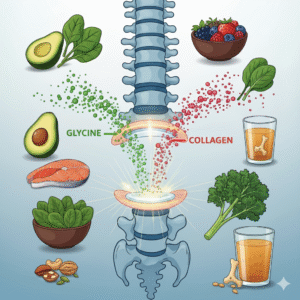
When you’re dealing with a bulging, herniated, or degenerating disc, most solutions focus on pain relief — not repair. But your discs are living tissue. That means they need raw materials to heal, just like a broken bone needs calcium and protein.
Nutrition is a crucial factor in spinal disc healing.
At the heart of this repair process is collagen, the structural protein that makes up most of your skin, joints, and spinal discs.
The #1 Limiting Factor: Glycine
Studies show that most people fall short by 5–10 grams of glycine every day.
Inadequate glycine levels can hinder spinal disc healing.
Even though glycine is labeled a “non-essential” amino acid (your body can make some), it may be the limiting factor in whether your body can actually produce enough collagen to repair damaged discs.
1/3 of all collagen is glycine
Without enough glycine, collagen fibers weaken
Weak collagen = sagging skin, aging joints, fragile discs
In short: if you don’t get enough glycine, your discs may struggle to repair themselves.
Understanding the role of glycine can enhance spinal disc healing.
Your spinal discs aren’t random tissue. They’re built from a very specific amino acid “recipe”:
Each component plays a role in spinal disc healing.
Glycine (≈ 33%) – foundation amino acid
Proline + Hydroxyproline (≈ 25%) – proline becomes hydroxyproline with the help of vitamin C
Alanine (≈ 10%) – adds flexibility and stability
Other amino acids – lysine, arginine, etc.
Vitamin C – activates collagen assembly
Iron – required for collagen synthesis
Copper – strengthens collagen cross-links
Zinc – helps repair damaged collagen
Manganese, silica, sulfur – smaller but vital roles
Miss even one of these, and disc repair slows down.
Legendary strength coach Charles Poliquin, who trained 17 Olympic gold medalists and 10 world record holders across more than a dozen sports, knew this truth well.
He understood that success wasn’t just about training — it was about providing the nutrients the body needed to rebuild faster than it broke down. Glycine may not be “essential” by definition, but in real-world recovery, it’s often the missing link.
He emphasized the importance of nutrition in spinal disc healing.
Glycine-rich foods support spinal disc healing.
You can boost your daily glycine intake through:
Glycine supplements that are relatively inexpensive
Collagen peptides or hydrolyzed collagen powders
Bone broth or gelatin (rich in connective tissue)
Bone broth is particularly beneficial for spinal disc healing.
Meat cuts with skin, cartilage, or tendons
Plant-based sources (soy protein, beans, spinach — though harder to reach optimal levels)
Many patients find it easier to bridge the gap with supplementation combined with vitamin C and trace minerals.
If you’re struggling with:
A herniated disc
Bulging disc
Degenerative disc disease
Degenerative disc disease requires focused strategies for spinal disc healing.
Chronic low back pain
…then providing your body with the raw materials for collagen repair can make the difference between slowing degeneration and truly supporting healing.
Nutrition directly influences spinal disc healing outcomes.
Nutrition won’t replace advanced care like DRX9000 spinal decompression, but without the right building blocks, your discs are fighting with one hand tied behind their back.
Collagen provides the amino acids — especially glycine and proline — that your discs need for repair. While supplements won’t “fix” a herniation overnight, they can help support the body’s natural rebuilding process when combined with proper care.
Supporting spinal disc healing can enhance recovery.
Most research suggests an extra 5–10 grams/day can help cover the modern diet shortfall. This can be achieved with collagen peptides, bone broth, or pure glycine powder.
Yes. Vitamin C is essential to activate the conversion of proline into hydroxyproline, a critical step in collagen stability. Without it, collagen synthesis is impaired — even if you’re taking plenty of collagen.
Collagen or gelatin-rich foods (bone broth, slow-cooked meats)
Foods that support spinal disc healing are essential for recovery.
Vitamin C-rich fruits/veggies (kiwi, bell peppers, citrus)
Mineral-rich foods (shellfish for zinc/copper, leafy greens for iron/manganese)
Focus on glycine to improve spinal disc healing.
Glycine isn’t just for skin health — it’s the foundation of your spinal discs.
If you want stronger skin, stronger joints, and stronger discs, the answer isn’t just treatment. It’s also nutrition. Give your body what it needs to make collagen, and you’ll be supporting healing from the inside out.
Nutrition is vital for spinal disc healing and overall health.
Healthy skin and a healthy spine are built from the same foundation. Prioritize spinal disc healing through proper nutrition. Support your collagen, support your life.
⚠️ Disclaimer: This article is for educational purposes only and should not be taken as medical advice. Always consult with a qualified healthcare provider about your specific condition.


