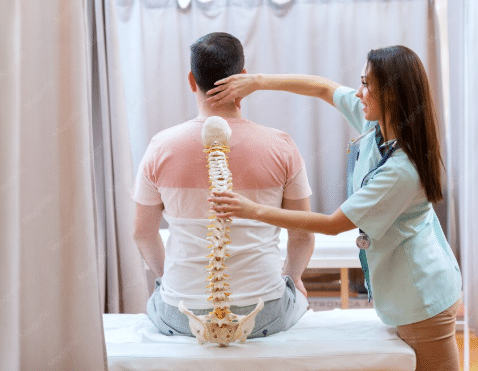
A herniated disc can cause more than back or neck pain. Some people experience pain traveling into an arm or leg, tingling, numbness, or weakness. When symptoms persist, an important question often follows: Should I try chiropractic adjustments, spinal decompression, or something else?
The answer depends on what is causing the symptoms, the findings on your examination, and whether any warning signs are present. Chiropractic care and non-surgical spinal decompression are different approaches. Neither is automatically the right treatment for every disc problem, and both should be considered within a broader plan that may include exercise, activity modification, medication, or medical referral.
Spinal discs sit between the vertebrae and help distribute forces during movement. Each disc has a tougher outer ring (annulus fibrosus) and a softer central portion (nucleus pulposus). A herniation occurs when disc material extends beyond its usual boundary. Depending on its location, it may irritate or compress a nearby nerve root.
A lumbar disc herniation can cause sciatica: pain, tingling, or numbness traveling into the buttock or leg. A cervical disc herniation can cause symptoms into the shoulder, arm, or hand. Importantly, many disc abnormalities appear on MRI in people who have no pain. An MRI finding needs to be interpreted alongside the history and neurological examination—not treated in isolation.
A chiropractic adjustment is a clinician-applied movement or force directed at a joint. Chiropractic care may also include gentler mobilization, soft-tissue treatment, therapeutic exercise, and guidance on daily activities. For some people with uncomplicated mechanical back or neck pain, spinal manipulation can provide modest improvements in pain or function.
An adjustment does not literally push a herniated disc back into place. In patients with radiating pain, progressive neurological findings, significant spinal instability, or other concerning conditions, the clinician must consider whether manipulation is appropriate, whether a modified approach is safer, or whether medical evaluation should come first.
Non-surgical spinal decompression uses a motorized table to apply controlled traction to the spine. Frisco Spinal Rehab uses the DRX9000 system as one option for selected patients with disc-related symptoms. During a session, the patient lies on the table while a programmed sequence of traction and relaxation is delivered.
The intended purpose is to temporarily change mechanical loading and potentially reduce symptoms in appropriately selected patients. It is important to distinguish the device’s proposed mechanism from proven clinical outcomes: studies of traction for low back pain and sciatica have produced mixed findings, and evidence does not establish that the DRX9000 permanently pulls a herniated disc back into place, regenerates a disc, or reliably prevents surgery.
A patient’s response should be monitored. If symptoms worsen, treatment should be reassessed rather than continued automatically.
| Question | Chiropractic adjustments | DRX9000 decompression |
| How is it delivered? | Hands-on joint manipulation or mobilization | Computer-controlled traction on a treatment table |
| Main clinical focus | Selected mechanical spinal and joint symptoms | Selected disc-related symptoms where traction may be considered |
| Can it fix a herniation? | Not proven to reposition a herniated disc | Not proven to permanently retract or regenerate a disc |
| Is it right for everyone? | No; examination and contraindication screening matter | No; examination and contraindication screening matter |
| Role in a plan | May accompany exercise and rehabilitation | May be considered alongside rehabilitation, with response reassessed |
An individualized plan emphasizing education, staying appropriately active, and exercise is often a reasonable starting point. Manual therapy, including chiropractic care, may be considered when examination findings support its use. An MRI showing disc degeneration alone does not mean decompression is necessary.
Radiating symptoms can suggest nerve-root irritation, but they can also have other causes. A clinician should assess strength, reflexes, sensation, symptom distribution, and provocative movements. When a disc-related cause is likely, conservative options may include activity modification, exercise-based rehabilitation, medication coordinated with a medical clinician, and—where appropriate—a carefully monitored trial of traction. No single approach is guaranteed to outperform the others.
Progressive weakness, significant neurological deficits, or severe symptoms require timely medical assessment. Emergency evaluation is needed for new bowel or bladder dysfunction, numbness in the saddle area, or rapidly progressive leg weakness. Sudden arm or leg weakness accompanied by facial drooping or speech changes can signal stroke and requires emergency care.
Sometimes. They are not necessarily competing services. A clinician may choose exercise, gentle manual techniques, or a monitored trial of traction at different points in care. However, combining more treatments is not automatically better. Each component should have a clear purpose, reasonable safety profile, and measurable goals—such as improved walking tolerance, less radiating pain, better sleep, or improved daily function.
At Frisco Spinal Rehab, treatment decisions can draw on chiropractic care, DRX9000 decompression, rehabilitation, and adjunctive technologies such as MLS laser therapy. Laser may be used for selected musculoskeletal pain complaints, but it should not be described as proven to heal or rehydrate a herniated disc. A thoughtful plan may also involve referral when symptoms or findings warrant additional medical evaluation.
No. The DRX9000 applies controlled mechanical traction; an adjustment involves a clinician-directed joint movement or force. They are different techniques with different potential indications.
Many people with disc-related symptoms improve with time and conservative care. A chiropractor may participate in that care when appropriate, but should also recognize when further medical testing or specialist referral is needed.
Some proposed explanations involve changes in intradiscal pressure, but the degree to which those changes occur in individual patients—and translate into lasting clinical benefit—is uncertain. Marketing claims about vacuuming a disc back into place should be viewed cautiously.
There is no universally established session count that fits every patient. Any proposed course should be based on an evaluation, transparent discussion of costs and alternatives, and regular assessment of meaningful progress.
Not always. MRI is most useful when it can change management, such as in certain persistent radicular symptoms, progressive neurological deficits, or when procedures or surgical consultation are being considered. If you already have an MRI, reviewing it together with your symptoms and examination can be helpful.
At Frisco Spinal Rehab in Frisco, Texas, our goal is to help patients understand the likely source of their pain and discuss reasonable conservative options—not to recommend the same treatment for everyone. If you already have a lumbar or cervical MRI, ask about our Free MRI Review. An MRI review is educational and does not replace a complete examination or medical diagnosis. Contact the office to confirm availability and next steps.
If you have worsening weakness, new bowel or bladder problems, or numbness around the groin, seek urgent medical attention rather than scheduling routine treatment.


