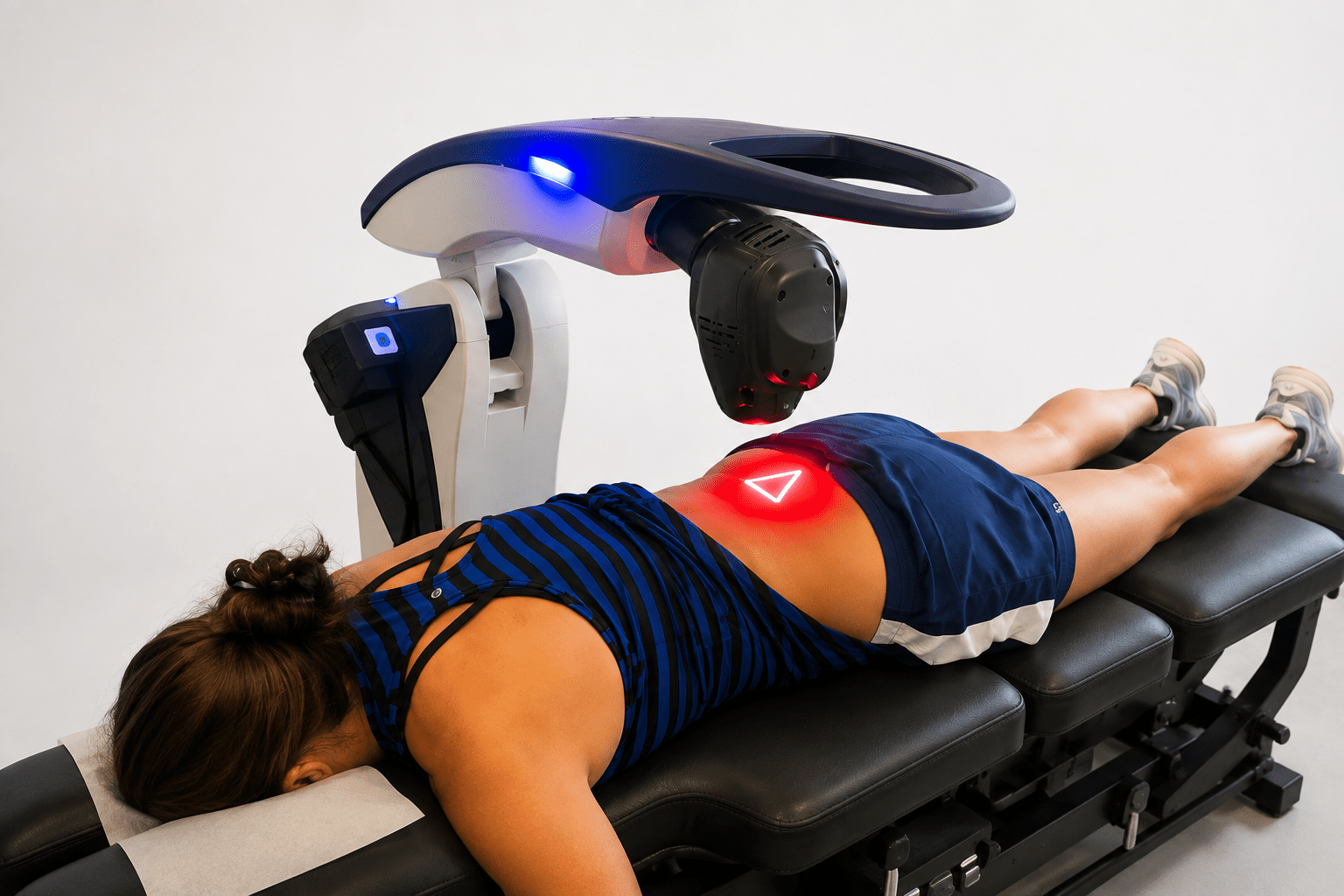
For patients struggling with a herniated disc, sciatica, or persistent lower back pain, treatment often focuses on relieving symptoms. But what if a non-surgical therapy could also help reduce the size of the disc herniation itself?
A randomized controlled trial published in August 2026 in Photobiomodulation, Photomedicine, and Laser Surgery offers encouraging evidence that high-intensity laser therapy (HILT) may do more than reduce pain.
Researchers found that patients receiving high-intensity laser therapy alongside therapeutic exercises experienced greater improvements in disc herniation measurements, pain, and functional disability than patients receiving sham laser treatment with the same exercises.
At Frisco Spinal Rehab, we believe findings like these support continued investigation into non-surgical treatment options. Our Disc Recovery Protocol incorporates advanced technologies, including MLS robotic laser therapy and DRX9000 spinal decompression, to address the needs of patients with disc-related conditions.
What Did the 2026 Laser Therapy Study Find?
The study, titled Effect of High-Intensity Laser Therapy on Disc Size and Functional Outcome in Patients with Lumbar Disc Herniation, included 40 patients between the ages of 30 and 45.
All participants had lumbar disc herniations at L4-L5 or L5-S1 with associated lumbosacral radiculopathy.
Researchers randomly divided participants into two groups:
Both groups underwent treatment three times per week for six weeks.
Researchers used MRI to measure changes in disc herniation dimensions. They also evaluated pain using the Visual Analogue Scale (VAS) and disability using the Oswestry Disability Index (ODI).
The Results Were Encouraging
| Outcome | HILT + exercise | Sham laser + exercise |
| Reduction in pain scores | 63.88% | 26.04% |
| Reduction in disability scores | 53.5% | 24.58% |
| MRI-measured disc herniation dimensions | Significant reductions | Smaller changes |
The laser treatment group demonstrated statistically significant improvements in all measured disc herniation dimensions compared with the control group.
These findings are particularly interesting because the researchers evaluated structural changes using MRI rather than relying exclusively on patients’ descriptions of pain.
However, this was a relatively small study involving 40 patients. Larger trials with longer follow-up periods are needed to determine how consistently these findings can be reproduced and whether the improvements persist.
A lumbar disc herniation occurs when disc material extends beyond its normal boundaries. Depending on its location and the surrounding anatomy, the herniation may contribute to inflammation or irritation of nearby spinal nerves.
Common symptoms include:
Reducing a herniation’s size may be beneficial in some patients, particularly when the disc material is contributing to nerve irritation.
However, MRI findings do not always correlate directly with pain or disability. A smaller herniation does not guarantee symptom resolution, and some patients improve even without major changes in disc size.
The goal of treatment should therefore include improvements in pain, mobility, daily function, and neurological health—not MRI measurements alone.
At Frisco Spinal Rehab, our preferred laser system is the MLS M6 Robotic Laser, an advanced therapeutic laser designed to deliver photobiomodulation treatment.
MLS stands for Multiwave Locked System. This technology uses synchronized laser wavelengths and is intended to support therapeutic effects involving pain modulation and tissue responses.
MLS laser therapy is noninvasive and does not require injections or surgical incisions.
Our clinical interest in MLS laser therapy includes its potential role in helping manage pain and inflammation associated with musculoskeletal conditions.
Not exactly.
The 2026 clinical trial investigated high-intensity laser therapy, but it did not specifically establish that the MLS M6 system produces the same results.
Different therapeutic lasers can vary in wavelength, power, energy delivery, treatment protocols, and other technical characteristics.
For this reason, we view the study as encouraging evidence for further investigation into laser-based treatment of lumbar disc herniations—not proof that every laser system will reduce disc size.
We selected MLS technology for our clinic because of its treatment capabilities and suitability for our broader rehabilitation approach.
At Frisco Spinal Rehab, we believe disc-related conditions often benefit from an individualized treatment strategy rather than relying on a single modality.
Our Disc Recovery Protocol may incorporate two complementary technologies.
The DRX9000 is a motorized spinal decompression system designed to apply controlled traction forces to the spine.
The treatment aims to reduce mechanical loading and may help certain patients manage symptoms associated with disc-related conditions.
Patients are evaluated to determine whether spinal decompression is appropriate based on their symptoms, examination findings, imaging, and medical history.
MLS laser therapy may be used as an additional modality to help manage pain and support rehabilitation.
While spinal decompression focuses on the mechanical environment of the spine, therapeutic laser treatment uses light energy to influence biological responses in tissues.
These different treatment approaches are the reason we consider them potentially complementary.
Importantly, the 2026 study did not evaluate MLS laser therapy combined with DRX9000 decompression. Further research is needed to establish whether combining these technologies produces better outcomes than either treatment alone.
Depending on the patient’s condition, examination findings, and treatment goals, our Disc Recovery Protocol may include:
DRX9000 spinal decompression: A non-surgical option intended to address certain mechanical aspects of disc-related pain.
MLS robotic laser therapy: A noninvasive modality that may help with pain management as part of a comprehensive treatment program.
Therapeutic exercises and rehabilitation: Individualized exercises intended to improve strength, movement, and functional capacity.
Additional supportive therapies: Selected when clinically appropriate based on the patient’s needs and response to care.
Not every patient needs every treatment, and not every disc herniation is appropriate for decompression or laser therapy.
Our goal is to determine which conservative treatment options make sense for the individual patient.
Many lumbar disc herniations improve over time with conservative management. Some herniations also decrease in size naturally as the body gradually resorbs disc material.
The 2026 study adds an interesting possibility: high-intensity laser therapy may contribute to measurable improvements in disc herniation dimensions when combined with exercise.
However, the study does not establish the biological mechanism responsible for the observed MRI changes, nor does it prove that laser therapy accelerates natural disc resorption.
For patients who have not improved with rest, medication, physical therapy, or other conservative approaches, a careful reassessment can help determine whether additional non-surgical options are appropriate.
Progressive muscle weakness, bowel or bladder dysfunction, or symptoms suggesting cauda equina syndrome require urgent medical evaluation rather than routine conservative treatment.
Frisco Spinal Rehab has served patients in Frisco and surrounding communities for more than two decades.
Our clinic offers advanced non-surgical treatment options, including DRX9000 spinal decompression and MLS robotic laser therapy.
We work with patients experiencing lumbar disc herniations, sciatica, chronic lower back pain, and certain cervical disc-related conditions.
If you’re struggling with persistent symptoms and want to explore whether our Disc Recovery Protocol may be appropriate, we invite you to schedule an evaluation.
Our introductory Disc Recovery Evaluation includes a consultation, examination, review of available MRI findings, and an initial DRX9000 treatment when clinically appropriate.
Frisco Spinal Rehab
3535 Victory Group Way, Suite 310
Frisco, TX 75034
Phone: (972) 712-7744
Learn more about our Disc Recovery Evaluation
Treatment recommendations are individualized. Laser therapy and spinal decompression are not guaranteed to reduce disc herniation size or eliminate symptoms. Some patients require medical or surgical management.
Scientific Reference
Mohammed WAA, Salem NA, Mohasseb AM, Zakaria HM, Ibrahim ZM, Darwesh AA.
Effect of High-Intensity Laser Therapy on Disc Size and Functional Outcome in Patients with Lumbar Disc Herniation.
Photobiomodulation, Photomedicine, and Laser Surgery. 2026;44(8):505–512.
DOI: 10.1177/25785478261465275
PMID: 42380073


