For decades, degenerative spinal discs have largely been viewed as structures that simply wear out over time.
The disc loses water. The space between the vertebrae narrows. The outer fibers weaken. A disc may bulge or herniate. Inflammation can develop, and nearby spinal nerves may become irritated or compressed.
Once this process begins, many patients assume there is nothing that can be done to influence the disc itself.
But an intriguing area of research is asking a very different question:
Can certain wavelengths of light actually influence the biology of a damaged spinal disc?
Researchers studying photobiomodulation (PBM), commonly called laser or light therapy, have begun looking at its effects on inflammation, disc cells, extracellular matrix breakdown and even degenerative changes visible on MRI.
Some of the findings are fascinating.
But there’s an important distinction from the beginning:
The research does NOT prove that laser therapy can regenerate a degenerative human spinal disc.
What it does show is that light can produce measurable biological effects in human disc cells and has produced intriguing results in animal models and preliminary human research.
Let’s look at what scientists have actually found.
A healthy intervertebral disc is much more than a cushion between two bones.
The center of the disc—the nucleus pulposus—contains a water-rich extracellular matrix that helps the disc absorb and distribute forces.
Surrounding it is the annulus fibrosus, a tough layered structure that helps contain the nucleus.
With degeneration, the biology of the disc begins to change.
Inflammatory substances can increase while enzymes called matrix metalloproteinases (MMPs) and other proteins begin breaking down components of the extracellular matrix.
Think of the extracellular matrix as the structural framework that helps give the disc its mechanical properties.
When breakdown begins to exceed repair, degeneration can progress.
That is why one particular laboratory experiment caught researchers’ attention.
In a 2018 study published in Scientific Reports, researchers obtained human nucleus pulposus cells from actual intervertebral discs removed during surgery.
They then exposed those cells to inflammatory conditions designed to reproduce some aspects of the environment seen in degenerative discs.
The researchers applied photobiomodulation using several wavelengths and doses.
What happened?
The light altered the activity of enzymes involved in degradation of the extracellular matrix. In particular, PBM selectively inhibited production of several matrix-modifying enzymes depending upon the wavelength and dose used.
That’s important because these weren’t skin cells or generic laboratory cells.
They were human nucleus pulposus cells—the cells from the center of a spinal disc.
Does that mean shining a laser over someone’s lower back will regenerate their disc?
No.
The cells in this experiment were exposed directly to light in a laboratory. That’s dramatically different from attempting to deliver an effective dose of light through skin, fat, muscle and other tissues to a disc located deep inside the human body.
But biologically, the finding is intriguing:
Human disc cells appear capable of responding to light.
Another study examined the effects of phototherapy on inflammation in human nucleus pulposus cells.
Researchers created an inflammatory environment involving macrophage-derived factors. The disc cells subsequently produced increased levels of inflammatory and matrix-related substances, including IL-6, IL-8 and MMPs.
After phototherapy, researchers found that expression of the inflammatory factor IL-6 was reduced across the wavelengths and doses tested, while other inflammatory and metabolic responses were also affected.
Researchers have also performed similar experiments involving cells from the annulus fibrosus, the outer portion of the disc.
In that research, photobiomodulation altered the production of enzymes involved in extracellular-matrix metabolism under experimentally induced degenerative conditions.
Taken together, these studies raise an interesting possibility:
Light may be capable of influencing some of the inflammatory and degenerative pathways occurring inside intervertebral-disc cells.
But laboratory cells are only the beginning.
What happens in an actual living disc?
A 2023 study investigated a 970-nanometer diode laser in rabbits with experimentally induced intervertebral-disc degeneration.
The researchers weren’t simply measuring whether the rabbits appeared to have less pain.
They examined the actual discs.
And the findings were fascinating.
Compared with untreated degenerative discs, laser-treated discs demonstrated reduced levels of the inflammatory cytokine IL-1β.
Researchers also found reductions in two enzymes associated with extracellular-matrix degradation:
MMP-13 and ADAMTS-5.
At the same time, the laser-treated discs demonstrated increased expression of type II collagen and aggrecan, important components associated with the disc’s extracellular matrix.
And then there was the MRI finding.
The researchers reported increased T2-weighted signal intensity within the nucleus pulposus and less progression of degeneration in the laser-treated animals.
They concluded that the 970-nm laser appeared to reduce matrix degradation and ameliorate disc degeneration in this rabbit model, potentially through inhibition of the p38 MAPK inflammatory pathway.
That is a remarkable experimental result.
But there are two words that must remain attached to it:
In rabbits.
Animal research is extremely useful for understanding biological mechanisms, but results in a rabbit disc cannot automatically be assumed to occur in a human lumbar disc.
Another study took advantage of an unusual situation.
Researchers studied 60 patients who were already scheduled to undergo lumbar disc surgery.
Thirty received laser treatment and thirty received placebo treatment.
Then, when the patients underwent discectomy, researchers were able to examine the actual disc material removed during surgery.
According to the study, tissue from the laser-treated patients demonstrated a greater presence of mucopolysaccharides and newly formed elastic fibers compared with the placebo group, with a statistically significant difference reported between the groups.
This is interesting because researchers weren’t simply asking patients:
“Does your back feel better?”
They were examining human intervertebral-disc tissue after laser exposure.
However, this is not sufficient evidence to conclude that external laser therapy regenerates human spinal discs. The study is relatively small, the literature has not established this finding through large independent trials, and tissue-level findings don’t necessarily translate into meaningful restoration of disc structure or function.
Still, it’s certainly a study worth knowing about.
At this point, we don’t know—and the evidence does not justify making that claim.
There is a major scientific gap between:
Light produces biological changes in disc cells
and:
External laser therapy regenerates a degenerative disc inside a human being.
Those are very different statements.
The existing research provides evidence at several levels:
Human disc cells: Photobiomodulation can influence inflammatory and extracellular-matrix pathways.
Animal discs: Near-infrared laser treatment has produced measurable biochemical, histological and MRI changes in experimentally degenerated discs.
Human disc tissue: One small study reported differences in disc tissue after laser treatment compared with placebo.
What we don’t yet have is convincing clinical evidence showing that external laser therapy restores disc height, reverses human disc degeneration or regenerates a damaged lumbar disc on MRI.
That distinction matters.
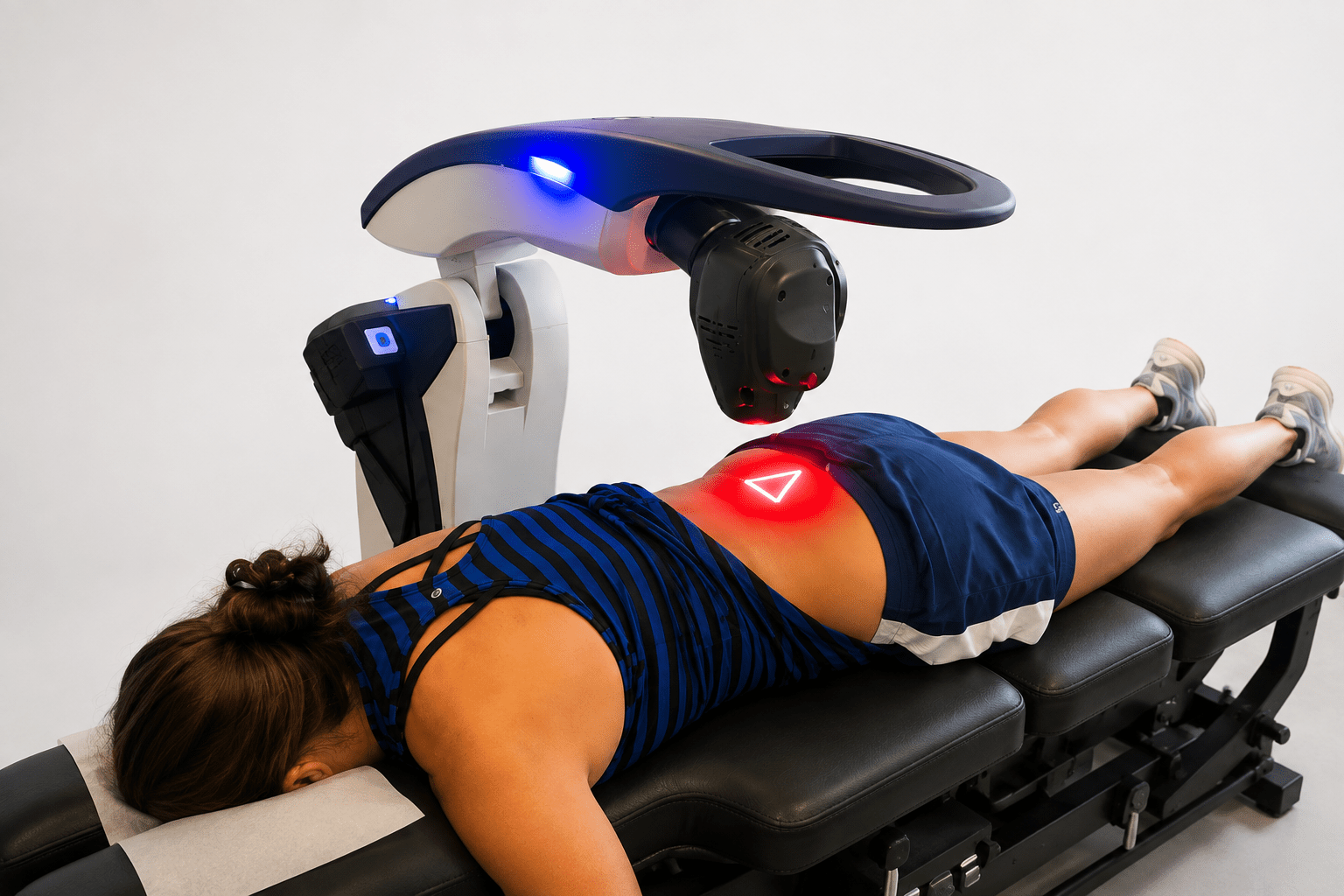
At Frisco Spinal Rehab, we use an MLS M6 robotic laser system.
MLS technology uses synchronized 808-nm and 905-nm wavelengths.
Those parameters are not identical to the experimental studies discussed above.
For example, the rabbit disc study used a 970-nm diode laser, while the human disc-cell experiments investigated different wavelengths.
Therefore, it would be inappropriate to take those studies and say:
“Research proves the MLS M6 regenerates spinal discs.”
It doesn’t.
The more accurate—and considerably more interesting—conclusion is this:
Researchers have demonstrated that photobiomodulation can affect the biology of human intervertebral-disc cells, and animal research suggests certain forms of near-infrared laser therapy may influence inflammation and extracellular-matrix degradation inside a degenerating disc.
Whether an externally applied MLS treatment can produce similar biological effects inside a deep human lumbar disc remains an unanswered question.
This is where two different questions are often confused.
The first question is:
Can laser therapy help someone experiencing pain associated with a disc problem?
The second is:
Can laser therapy structurally regenerate the damaged disc?
Those aren’t the same question.
Photobiomodulation has been studied much more extensively for its effects on pain, inflammation and musculoskeletal conditions than it has for actual regeneration of human spinal discs.
A person could potentially experience improvement in pain or function without the disc itself being structurally regenerated.
That’s common throughout medicine.
Pain and tissue structure don’t always change together.
At Frisco Spinal Rehab, many of the patients we evaluate have problems involving:
Our approach is not based on the idea that one technology magically fixes every component of a spinal problem.
Instead, we’re interested in understanding the different pieces of the problem.
For appropriate patients, DRX9000 spinal decompression is used as a mechanical treatment intended to address forces affecting the spine and discs.
MLS laser therapy approaches the problem from a different direction, using photobiomodulation.
Hands-on care and rehabilitation may address still other aspects of function and movement.
That’s also why emerging research into the biology of the intervertebral disc is so interesting to us.
The laboratory research tells us something important:
A degenerating spinal disc isn’t necessarily biologically inert.
Its cells respond to inflammatory signals.
They regulate enzymes.
They produce and degrade extracellular-matrix components.
And under laboratory conditions, those processes can be influenced by light.
Animal research takes that concept another step further by showing measurable changes inside living degenerative discs following certain laser treatments.
What science still needs to determine is whether externally delivered photobiomodulation can reliably deliver an adequate therapeutic dose to a deep human spinal disc and whether doing so produces meaningful long-term structural or clinical changes.
That’s the study we’d really like to see.
So, can laser therapy actually help a damaged spinal disc?
The answer depends on what we mean by help.
There is fascinating preliminary evidence that photobiomodulation can influence inflammation, extracellular-matrix metabolism and other biological processes associated with intervertebral-disc degeneration.
Human disc cells respond to light in laboratory experiments.
Animal studies have produced biochemical and MRI changes in degenerating discs.
And a small human study reported intriguing differences in surgically removed disc tissue following laser treatment.
But none of this proves that an externally applied MLS laser can regenerate a degenerative human spinal disc.
The science is intriguing. The biological possibility deserves further study. But the evidence isn’t yet strong enough to claim human disc regeneration.
And sometimes that’s what makes medical research most interesting:
We know considerably more than we did twenty years ago—but there are still some very important questions waiting to be answered.
At Frisco Spinal Rehab, we use MLS robotic laser therapy as one component of conservative care for appropriate patients with musculoskeletal and spine-related conditions. Treatment recommendations depend on the patient’s symptoms, examination, diagnosis and imaging when appropriate.
This article is for educational purposes only. It is not intended to diagnose a medical condition or imply that MLS laser therapy has been proven to regenerate intervertebral discs. Individual results and treatment recommendations vary.


