If you’re dealing with sciatica, you’re probably asking one question:
For many people, the answer is yes.
Sciatica is one of the most common conditions we treat at Frisco Spinal Rehab, and the vast majority of patients improve with conservative, non-surgical care. The key is choosing the right treatment for the actual cause of your sciatic nerve irritation—not simply masking the symptoms.
Here’s what you need to know about the most effective non-surgical treatment options and how to determine which one may be right for you.
Sciatica is not a diagnosis—it’s a symptom.
It occurs when the sciatic nerve becomes irritated or compressed, causing pain that typically travels from the lower back into the buttock and down the leg. Depending on the cause, you may also experience:
Because many different conditions can irritate the sciatic nerve, successful treatment begins with finding the underlying cause.
Several conditions can produce nearly identical symptoms.
These include:
Treating the wrong condition often leads to months of frustration.
That’s why an accurate examination—and often MRI review—is one of the most important parts of your recovery.
In many cases, yes.
Most patients do not require surgery, especially when treatment begins before significant nerve damage develops.
Surgery may become necessary if there is:
Fortunately, these situations are relatively uncommon.
For everyone else, conservative care is usually the recommended first step.
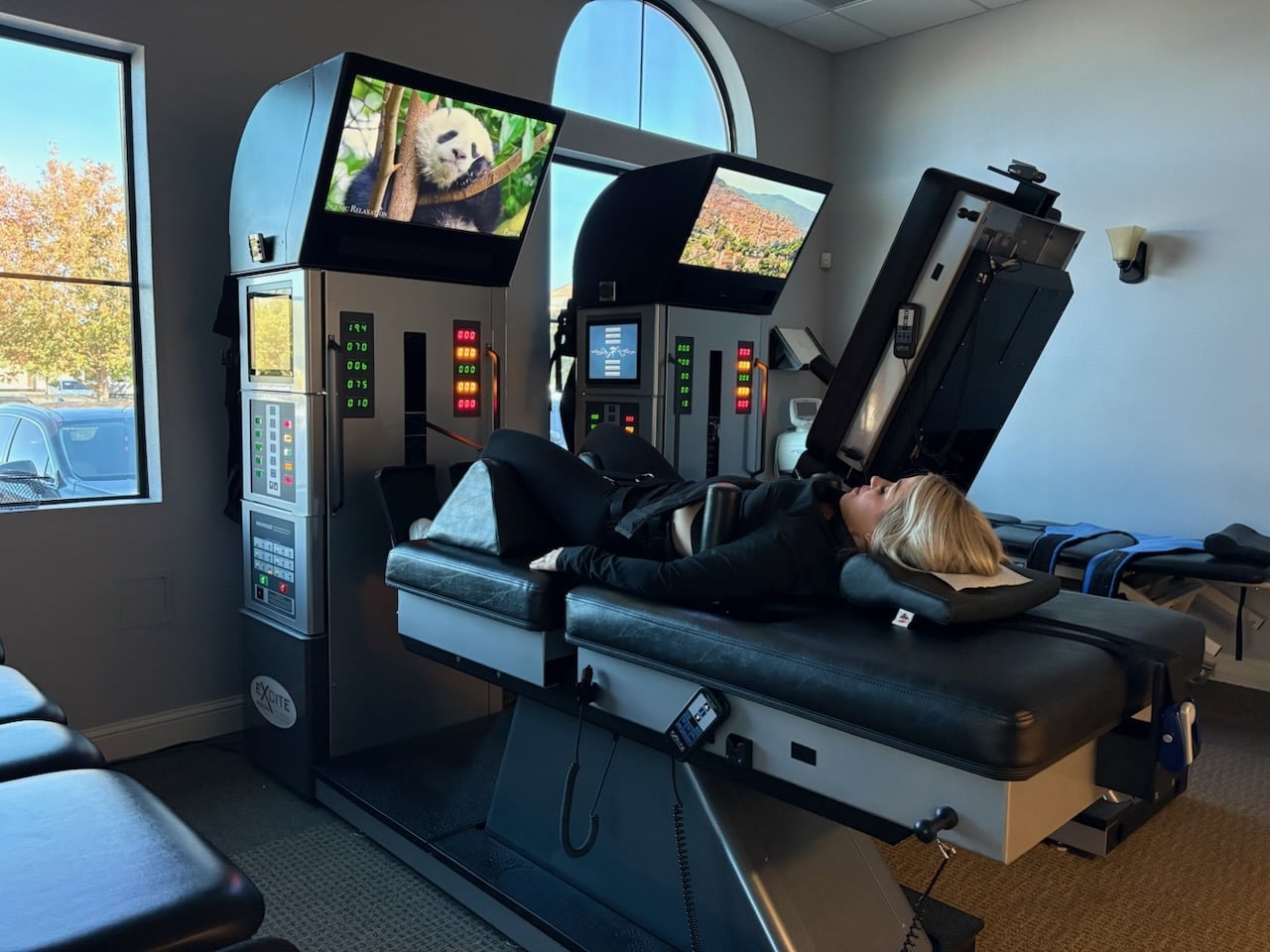
When sciatica is caused by a herniated or bulging disc, spinal decompression is often one of the most effective non-surgical options.
Unlike simple traction, advanced spinal decompression systems such as the DRX9000® use computerized treatment protocols designed to gently reduce pressure inside the affected spinal disc.
The goals are to:
Many patients who have already tried medications, injections, or physical therapy without lasting relief discover decompression is the missing piece.
Restricted spinal joints can place additional stress on irritated nerves.
Gentle chiropractic adjustments help restore normal spinal motion, improve biomechanics, and reduce unnecessary stress on surrounding tissues.
Treatment is customized based on your diagnosis and comfort level.
Pain relief alone isn’t enough.
Your spine also needs better support.
Specific rehabilitation exercises help:
The right exercise program depends on your diagnosis—not every exercise is appropriate for every type of sciatica.
Tight muscles frequently make sciatica worse.
Massage therapy and myofascial techniques can help:
Soft tissue therapy often works best when combined with other treatments rather than used alone.
Over-the-counter anti-inflammatory medications may temporarily reduce pain during acute flare-ups.
However, medications generally manage symptoms rather than correcting the underlying problem.
Long-term use should always be discussed with your physician due to potential side effects.
Steroid injections may decrease inflammation surrounding irritated nerves.
For some patients they provide meaningful short-term relief.
For others, improvement is minimal or temporary.
While injections can reduce pain, they do not repair damaged discs or correct spinal mechanics.
That depends entirely on what’s causing your sciatica.
| Cause | Treatment Often Recommended |
| Herniated disc | Spinal decompression + rehabilitation |
| Bulging disc | Decompression + chiropractic care |
| Muscle-related sciatica | Soft tissue therapy + exercise |
| SI joint dysfunction | Chiropractic + stabilization exercises |
| Degenerative changes | Combination treatment approach |
| Spinal stenosis | Conservative care, exercise, decompression (selected cases) |
There is no one-size-fits-all solution.
Patients who receive an accurate diagnosis typically recover faster because treatment is directed at the actual source of nerve irritation.
Recovery varies depending on:
Some patients notice improvement within a few visits.
Others with chronic disc injuries may require several weeks to achieve lasting results.
The goal isn’t simply reducing today’s pain—it’s preventing tomorrow’s recurrence.
Don’t ignore symptoms that continue to worsen.
You should schedule an evaluation if:
Early treatment often leads to faster recovery.
Every patient begins with a thorough evaluation designed to determine why the sciatic nerve is irritated.
After reviewing your history, examination findings, and any MRI studies, we develop an individualized treatment plan based on your diagnosis—not a one-size-fits-all protocol.
Depending on your condition, treatment may include:
Our goal isn’t simply to reduce pain for a few days.
It’s to help you return to the activities you enjoy while reducing the likelihood that your sciatica keeps coming back.
Is surgery usually necessary for sciatica?
No. Most people improve with conservative treatment and never require surgery.
Is spinal decompression painful?
No. Most patients describe the treatment as a gentle stretching sensation. Many even relax or fall asleep during treatment.
Can chiropractic care make sciatica worse?
When performed after a proper examination and diagnosis, chiropractic care is generally very safe and is often an effective part of a comprehensive treatment plan.
How do I know what’s causing my sciatica?
Because several conditions produce nearly identical symptoms, the only reliable way is through a professional examination and, when appropriate, imaging such as an MRI.
If you’ve been living with persistent leg pain, numbness, or tingling, don’t settle for treatments that only mask your symptoms.
At Frisco Spinal Rehab, we’ve spent more than 25 years helping patients identify the true source of their sciatica and develop personalized, non-surgical treatment plans designed for lasting relief.
Schedule your consultation today and take the first step toward getting back to the life you enjoy.
Written by Dr. David Kaff, DC
Owner, Frisco Spinal Rehabilitation


