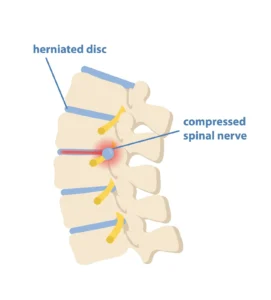
One of the most confusing moments for patients is when an MRI shows a herniated disc, but no one can clearly explain whether it’s truly the source of their pain.
People often say things like:
“My MRI shows a herniated disc, but I’m not sure that’s what’s causing it.”
“The doctor said I have disc problems, but also said lots of people have them.”
“How do I know if this is the real reason my back and leg hurt?”
It can feel frustrating and uncertain. On one hand, you have a diagnosis. On the other hand, you may still be wondering if it actually explains what you’re feeling day to day.
Herniated discs are frequently found on MRI scans. But the presence of a disc herniation doesn’t always mean it’s responsible for the pain.
Some people have herniated discs and feel fine.
Others have significant pain with only mild changes on imaging.
This is why the real question becomes:
Does the MRI finding match the symptom pattern?
There are certain patterns that tend to line up more closely with disc-related irritation.
People often notice symptoms like:
Burning or tingling sensations
Numbness in the foot or calf
Pain that worsens when sitting
Discomfort when bending forward
Trouble getting comfortable in certain positions
When symptoms follow this type of pattern, it can suggest the disc may be affecting a nearby nerve.
One of the strongest signs that a disc may be involved is when pain travels beyond the lower back.
People may feel:
Pain in the buttock
Pain down the thigh
Symptoms in the calf
Tingling or numbness in the foot
This happens because the nerves that travel into the leg begin in the lower back. If a disc is irritating one of those nerves, symptoms can appear along the nerve’s path.
Sometimes the leg hurts more than the back itself.
Many people with disc-related irritation notice that sitting increases symptoms.
Common patterns include:
Pain builds while sitting
Driving becomes uncomfortable
Standing up brings sharp discomfort
Relief comes when lying down
This happens because sitting changes pressure in the lower back and can make a sensitive area react more strongly.
Even when a disc is involved, symptoms don’t always stay constant.
People often notice:
Flare-ups
Periods of improvement
Then symptoms returning again
This can happen when the area becomes irritated during certain activities like:
Long drives
Lifting
Bending
Busy physical days
When the irritation settles down, the pain improves.
An MRI shows structure — what the spine looks like.
But it doesn’t show:
How sensitive a nerve is
How your body reacts to movement
How pressure changes affect symptoms
That’s why doctors often look at both:
The imaging
Your symptom pattern
To determine whether a disc is likely the main source of the problem.
Many people begin to suspect the disc is involved when they notice patterns like:
Pain always returning to the same spot
Leg symptoms following the same path
Sitting or bending consistently triggering discomfort
Temporary relief from treatments that calm inflammation
Over time, these patterns can help connect the MRI finding with what you’re feeling.
Even with imaging and symptoms, it can still feel unclear.
People often say:
“I don’t know if this disc is really the cause.”
“I’ve tried things and it still hurts.”
“I just want to understand what’s actually wrong.”
This uncertainty is very common, especially when the pain has been ongoing for months or years.
At Frisco Spinal Rehab, we often meet patients who come in with an MRI that shows a herniated disc but aren’t sure if it explains their pain. In many cases, the symptom patterns — especially leg pain, position-related discomfort, and recurring flare-ups — help paint a clearer picture.
Understanding how the disc interacts with nearby nerves and daily movement can make it easier to connect the dots between what the MRI shows and what the body is feeling.
A herniated disc on MRI doesn’t automatically mean it’s the source of your pain — but certain symptom patterns can make it more likely. Leg pain, tingling, numbness, and discomfort that changes with sitting or bending are often clues that the disc may be affecting a nearby nerve.
The most important piece of the puzzle isn’t just what the scan shows — it’s how closely your symptoms match what’s seen on imaging. Looking at both together can help provide a clearer understanding of what may be driving the pain.


