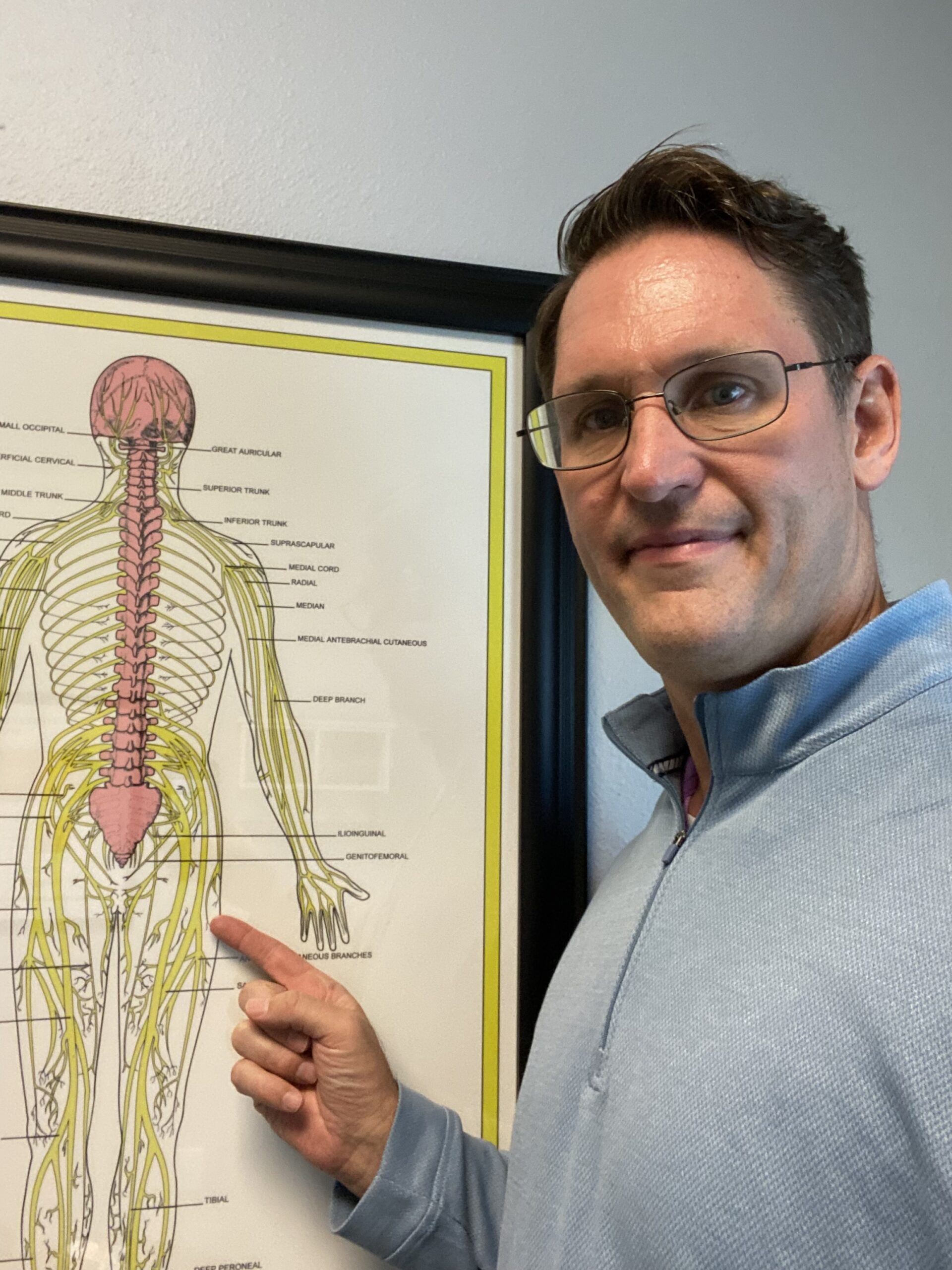
Sciatica has a way of getting a person’s attention. Back pain is one thing. Pain that leaves the lower back, runs through the buttock, and starts traveling down the leg feels different—and it often raises a much bigger question: Is this going to require surgery?
Not necessarily.
After approximately 25 years of treating spine and disc-related conditions in Frisco, we have seen sciatica range from an irritating ache into the buttock to severe leg pain with numbness or weakness. Those patients should not all be treated the same way.
The first job is to figure out what is irritating the nerve, how significantly the nerve is affected, and whether the clinical picture is appropriate for conservative care at all.
Patients often tell us, “I have sciatica,” as though sciatica itself identifies the underlying problem. It doesn’t.
Sciatica generally describes symptoms associated with irritation of nerve roots that contribute to the sciatic nerve. The cause can vary. A lumbar disc herniation or bulge may be involved. Narrowing around a nerve can contribute. Degenerative changes can alter the available space around neurological structures. Other conditions can produce symptoms that resemble sciatica.
That distinction matters because the treatment should follow the cause, not simply the name of the symptom.
We want to know exactly where the symptoms travel.
Do they stop in the buttock? Move down the back or side of the thigh? Reach the calf? Continue into the foot or toes? Is the sensation sharp, burning, aching, tingling, or numb? Is there actual weakness?
We also ask what changes the symptoms. Sitting may aggravate one disc-related presentation, while prolonged standing or walking may be more problematic in another. Coughing or sneezing can be relevant. So can bending, driving, getting out of a chair, or simply trying to sleep.
Those details help us build a neurological and mechanical picture before choosing a treatment.
When imaging is clinically appropriate or an MRI is already available, we compare it with the patient’s symptoms and examination.
We may look for a lumbar disc herniation or bulge, narrowing around a nerve root, central or foraminal stenosis, degenerative changes, and the spinal level involved. But an abnormal MRI does not automatically identify the source of the symptoms.
The useful question is whether the imaging finding matches the side, distribution, neurological findings, and behavior of the patient’s leg symptoms. We do not want to treat an MRI finding that has little to do with what the patient is experiencing.
Many cases of sciatica do not automatically require surgery. Depending on the cause, severity, duration, neurological findings, and overall health of the patient, conservative treatment may be appropriate.
That does not mean surgery is a failure or something that should be avoided at all costs. There are cases in which a surgical opinion is exactly what a patient needs. The objective is not “no surgery.” The objective is the right treatment at the right time.
For patients without urgent neurological findings, the decision often involves weighing the severity of symptoms, functional limitations, examination and imaging findings, response to conservative care, and the patient’s goals.
If the clinical picture suggests that sciatica is associated with a disc or nerve-related mechanical problem and the patient is an appropriate candidate for conservative treatment, spinal decompression may be considered.
Frisco Spinal Rehab uses multiple DRX9000 systems for spinal decompression. The DRX9000 provides computer-controlled, programmed traction to a selected spinal region. The treatment rationale is to change mechanical loading around targeted spinal structures and reduce pressure associated with certain disc and nerve-related conditions.
We do not put every patient with leg pain on a decompression table. If the history, examination, neurological findings, and imaging when relevant do not support decompression, another approach makes more sense.
Sciatica treatment does not have to be an either-or decision between a decompression machine and surgery.
Depending on the patient, conservative care may involve decompression, hands-on treatment, exercise, movement modification, and strategies for returning to normal activity. Someone whose symptoms are highly irritable may initially tolerate a different level of activity than someone who is already improving.
As symptoms change, the plan should change with them. Our goal is not simply to reduce today’s pain score. We want to know whether the patient can sit longer, walk farther, sleep better, work more comfortably, and return to normal activity without repeatedly provoking the leg symptoms.
With radiating leg symptoms, location can sometimes be as important as intensity.
For example, a patient may still have some lower-back discomfort while noticing that pain which previously traveled into the calf or foot is no longer going as far down the leg. That change can be clinically useful when considered with the rest of the examination and functional progress.
The reverse matters too. Symptoms that begin traveling farther down the leg, new numbness, or increasing weakness deserve attention rather than simply continuing the same treatment because the schedule says so.
Some neurological symptoms change the urgency of the situation.
Loss of bladder or bowel control, numbness in the saddle or groin region, or new or rapidly progressive significant weakness requires prompt medical evaluation. Severe or rapidly worsening neurological symptoms and certain other concerning findings can also require urgent assessment.
Conservative treatment should never delay necessary medical or surgical care.
For a patient without urgent neurological findings, non-surgical care may be reasonable when the history, examination, and available imaging support a condition that can appropriately be managed conservatively.
The important part is not simply choosing the least invasive treatment. It is choosing a treatment that makes sense for the actual cause of the symptoms and then monitoring whether the patient is improving.
If the clinical picture changes, the plan should change too.
Yes. A lumbar disc herniation can irritate or compress a nerve root associated with sciatic symptoms. Disc problems are not the only possible cause of leg pain, so evaluation remains important.
Many patients with sciatica are managed without surgery, depending on the cause and severity of the condition and the neurological findings. Some cases do require surgical evaluation.
DRX9000 spinal decompression may be considered for selected patients when sciatica appears related to an appropriate disc or nerve-related mechanical condition. It is not suitable for every cause of sciatica, and results vary.
Numbness can occur with nerve irritation or compression and deserves clinical evaluation. New or worsening neurological deficits, especially significant weakness or saddle-area numbness, can require more urgent medical attention.
The answer depends on the cause, irritability of the symptoms, neurological findings, and which movements provoke or relieve the problem. Appropriate activity is often preferable to unnecessary fear of movement, but exercise selection should fit the individual presentation.
A surgical consultation may be appropriate with significant or progressive neurological deficits, certain urgent findings, severe persistent symptoms, or when an appropriate course of conservative care has not produced adequate improvement. The decision is individualized.
If leg pain, numbness, tingling, or weakness is interfering with work, sleep, exercise, or normal daily activity, the most important first step is determining what is causing the sciatic symptoms.
Frisco Spinal Rehab has treated spine and disc-related conditions in Frisco for approximately 25 years and uses multiple DRX9000 systems for spinal decompression. Our goal is not to avoid surgery at all costs or put every sciatica patient through the same protocol. It is to identify the likely source of the symptoms, determine whether conservative care makes sense, and recognize when a different level of care is needed.


