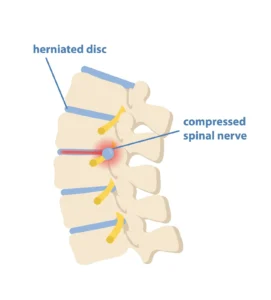
After seeing “bulging disc” on an MRI report, one of the most common questions people ask is:
“Can this go back to normal?”
“Will the bulge shrink?”
“Is this permanent?”
“Am I stuck with this forever?”
It’s a very understandable concern. The idea of something in your spine being “out of place” can feel unsettling, especially if you’re dealing with back pain, leg symptoms, or recurring flare-ups.
The good news is that symptoms related to bulging discs often improve. But the way healing happens isn’t always what people expect.
A bulging disc means the outer portion of the disc is extending outward slightly beyond its usual space.
This usually develops gradually over time due to:
Normal aging
Repetitive strain
Years of sitting
Lifting or bending habits
It’s one of the most common findings on MRI and is often seen in people who have no pain at all.
Sometimes, the disc may change over time. But more importantly, many people experience improvement in symptoms even if the disc still looks similar on imaging.
That’s because the goal isn’t always to make the disc look perfect — it’s to:
Reduce irritation
Calm inflammation
Improve function
Many people feel much better even though their MRI still shows a bulging disc.
A bulging disc can cause problems when it begins to irritate nearby tissues or nerves.
Over time, the body can adapt by:
Settling inflammation
Reducing sensitivity
Strengthening surrounding support
Improving movement patterns
As this happens, people may notice:
Less frequent flare-ups
Reduced leg symptoms
Less stiffness
Better tolerance for sitting or standing
This is often what people mean when they say they’re “healing.”
Even when symptoms improve, some people notice that pain can still return during certain situations, such as:
Long drives
Sitting too long
Lifting something heavy
Busy or stressful days
This happens because the area may remain sensitive to pressure and strain.
A common pattern is:
Pain improves
Life returns to normal
Something triggers irritation
Symptoms come back
This cycle can repeat for years.
One of the most surprising things for patients is that MRIs don’t always look dramatically different over time — even when someone feels much better.
This is because:
Imaging shows structure
Symptoms are about function and sensitivity
Many people improve because the area becomes less irritated, not because the disc completely disappears.
Not necessarily.
Many people live with bulging discs for years without significant progression. In some cases, the condition stays stable for long periods.
What matters most is:
How the spine handles daily stress
How often symptoms flare up
How much it affects quality of life
Many people discover they have a bulging disc after:
Physical therapy that helped temporarily
At that point, they often wonder if the disc can “go back in” or return to normal.
At Frisco Spinal Rehab, we often meet patients who are trying to understand what their MRI really means. In many cases, the disc finding helps explain the pattern of pain and flare-ups they’ve been experiencing, even if the disc itself doesn’t dramatically change on future scans.
A bulging disc doesn’t automatically mean permanent damage. Many people improve over time as inflammation settles and the body adapts.
But if the area continues to be irritated by daily pressure, sitting, or movement patterns, symptoms can come and go.
Understanding how the disc behaves — and what triggers symptoms — often helps people make sense of why the problem feels unpredictable.
A bulging disc doesn’t always return to a perfectly “normal” appearance, but symptoms often improve over time as the body adapts and irritation decreases.
For many people, healing means fewer flare-ups, less sensitivity, and better function — even if the MRI still shows a bulge. How you feel day to day is usually a more important measure than how the disc looks on imaging.


